In a striking address to Canada’s armed forces during the holiday season, Mark Carney delivered a message that may redefine the country’s defense doctrine for decades to come: Canada will no longer rely on foreign allies for its security. Framed not as a ceremonial speech but as a strategic declaration, Carney’s remarks outlined a sweeping shift toward military self-reliance, massive new defense spending, and renewed focus on Arctic sovereignty. With nearly $82 billion committed over five years and long-term plans extending to 2035, the speech signals a profound recalibration of Canada’s role in an increasingly unstable global order.

For generations, Canada’s defense posture rested on a quiet assumption: that the broader international system—anchored by American power—would remain stable, predictable, and ultimately protective. In his holiday address to the armed forces, Mark Carney made it clear that this assumption no longer holds. “The era of depending on others to guarantee our security is over,” he declared, drawing a firm line between Canada’s past and what he portrayed as an unavoidable future.
Delivered at a moment traditionally reserved for gratitude and morale-boosting, the speech stood out for its urgency and blunt realism. Carney did not speak in abstractions. Instead, he framed Canada’s security challenges as immediate, structural, and deeply connected to shifting global dynamics—trade disputes, geopolitical volatility, and a breakdown in long-standing certainties about alliances.
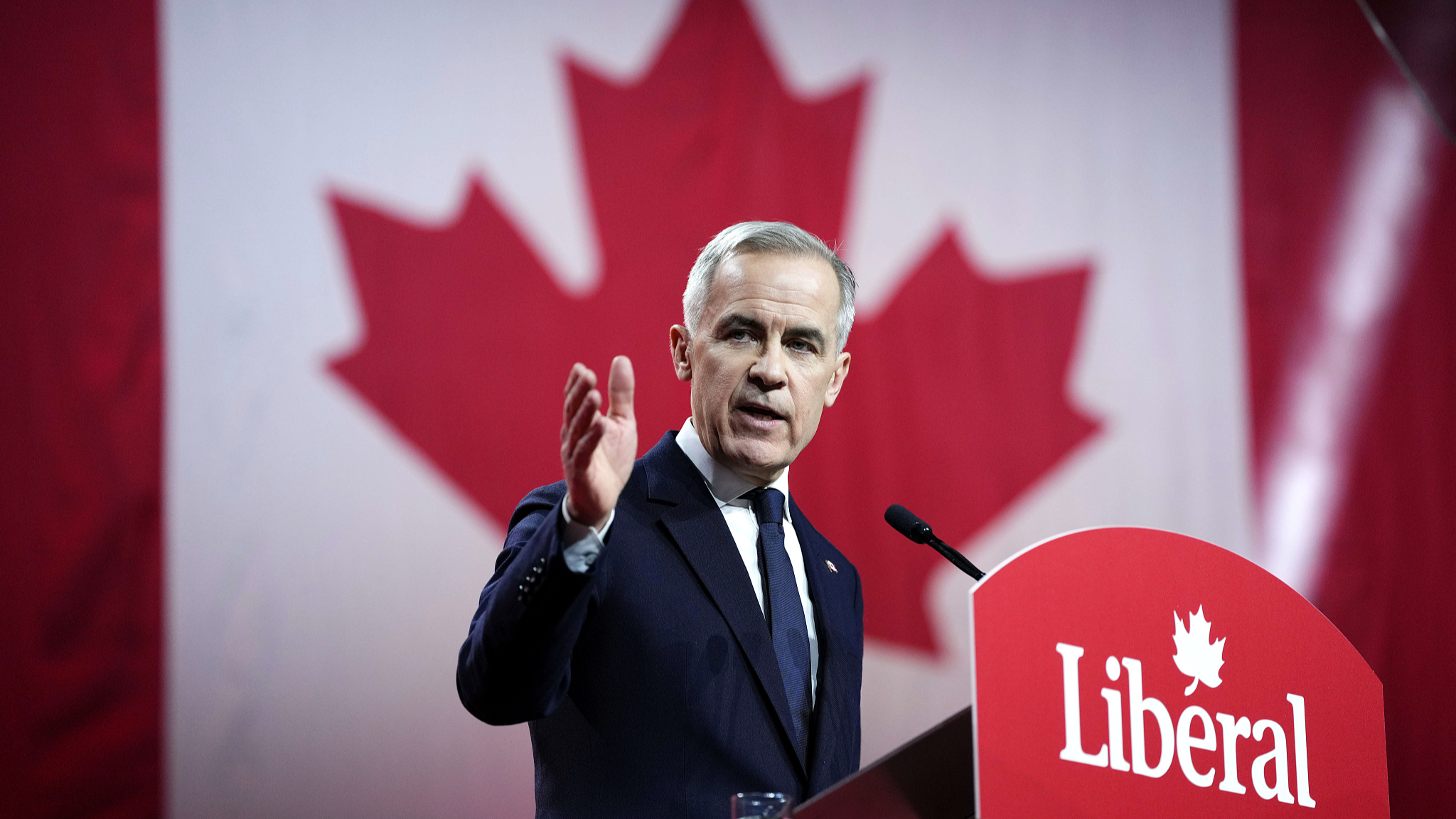
At the heart of Carney’s message was sovereignty—not as a slogan, but as a costly and deliberate choice. He announced nearly $82 billion in defense spending over the next five years, positioning Canada to reach NATO’s 2% of GDP defense benchmark ahead of schedule. More strikingly, he outlined a longer-term ambition: defense investment rising toward 5% of GDP by 2035. If realized, this would mark one of the most dramatic military expansions in modern Canadian history.
The funding, Carney emphasized, is not symbolic. It is intended to rebuild capacity across the board—recruitment, training, equipment, and industrial capability—after decades of underinvestment. Military personnel, he suggested, have long understood the risks of complacency better than civilians. Now, national policy is catching up to that reality.
One of the most consequential elements of the strategy is Canada’s renewed focus on the Arctic. As climate change accelerates ice melt and opens new shipping routes, the region has rapidly transformed from a remote frontier into a strategic crossroads. Carney warned that Canada can no longer afford to be underprepared—or underestimated—in the North. Sovereignty in the Arctic, he argued, will not be defended by maps or treaties alone, but by presence, capability, and readiness.
The speech also signaled a major shift in defense procurement philosophy. Historically, a large share of Canada’s military spending flowed to American contractors, reinforcing long-term dependence on foreign supply chains. Carney’s plan seeks to reverse that pattern by prioritizing Canadian industries and workers wherever possible. He was careful to frame this not as isolationism, but as strategic autonomy—arguing that true partnership with allies requires the ability to stand on one’s own.
Among the most eye-catching commitments was the planned acquisition of twelve new conventional submarines, a move that would significantly enhance Canada’s control over its maritime approaches. These long-term contracts are expected to anchor domestic manufacturing, create skilled jobs, and ensure that Canadian strategic priorities drive procurement decisions.
Air defense is also under review. Carney’s administration is reportedly exploring alternatives to American fighter jets, with an emphasis on building and maintaining aircraft within Canada. The rationale is straightforward: in a crisis, reliance on foreign production and maintenance can become a vulnerability. Domestic capability, by contrast, offers flexibility and resilience.

Beyond the technical details, the broader implications of the address are unmistakable. Carney is attempting to reposition Canada not as a junior partner sheltered by stronger allies, but as a serious security actor in its own right. The strategy is explicitly forward-looking, designed not merely to respond to today’s tensions but to deter future threats before they emerge.
Critics may question the cost, the ambition, or the political sustainability of such a sweeping transformation. Yet Carney’s speech suggests he views the alternative—continued dependency in an unstable world—as far more dangerous. Independence, he implied, is expensive, but insecurity is costlier.
As global audiences take note, Canada appears poised to redefine its international identity. No longer content to assume protection, the country is signaling a willingness to invest heavily in controlling its own destiny. In doing so, Carney has turned a holiday address into a historic marker: the moment Canada publicly declared that its security is, first and foremost, its own responsibility.