For years, Canada was defined by a single number: 59%. It was cited as proof that the country remained economically dependent on the United States, vulnerable to tariffs, pressure, and political mood swings in Washington. But that statistic is now misleading—and increasingly obsolete. Beneath the surface, Canada has undergone a quiet but consequential transformation. Faced with rising U.S. tariffs and geopolitical uncertainty, Canadian businesses and policymakers didn’t wait for relief. They diversified, redirected, and rebuilt. As a result, Canada is entering the next phase of trade negotiations not as a junior partner, but as a country that has learned how to thrive without relying on one market alone.

For decades, Canada’s economic story was simple—and risky. Roughly 70% of its exports flowed to the United States, tying Canadian prosperity to American trade policy. When relations were smooth, the system worked. When tariffs appeared, the vulnerabilities were exposed almost instantly.
Washington knew it. Ottawa knew it. And Canadian industries felt it.
But when U.S. tariffs escalated and threats became routine, something unexpected happened. Instead of scrambling for exemptions or waiting for political winds to shift, Canadian exporters began quietly changing course.
The pivot was swift—and strategic.
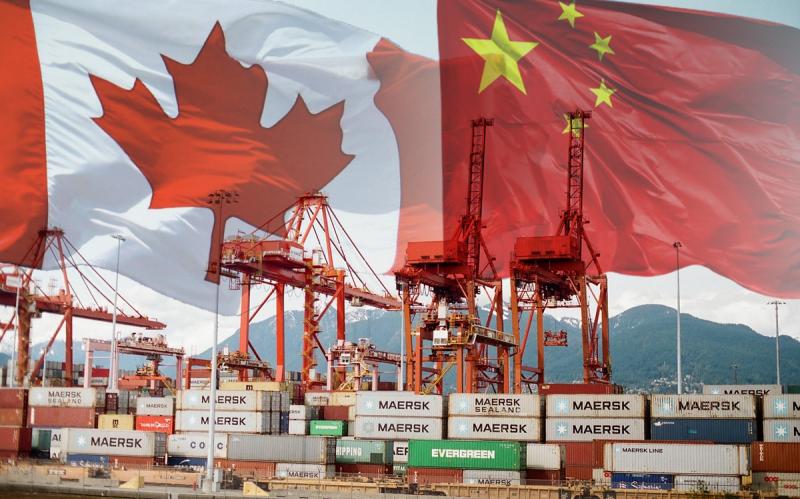
Rather than doubling down on U.S. access, Canadian companies expanded aggressively into Asia. Exports to China, Singapore, and Hong Kong surged. By the end of 2025, shipments to non-U.S. markets had climbed to nearly $8 billion annually—a scale that surprised not just analysts, but policymakers in Washington who had long assumed Canada had few alternatives.
This wasn’t improvisation. It was preparation paying off.
For years, Canada had invested in trade-enabling infrastructure that rarely made headlines. Westbound energy pipelines and port expansions were controversial domestically, but they proved decisive. Once completed, Canadian oil producers were no longer landlocked by U.S. demand. Access to Pacific markets tripled export capacity almost overnight, giving Canada leverage it had never truly possessed before.
Energy was only part of the story.
Manufacturing, agriculture, and advanced materials followed similar paths. Canadian firms restructured supply chains, built new logistics networks, and cultivated buyers across 27 different trading partners. In less than two years, they recovered nearly $11 billion of the $18.5 billion lost to U.S. tariffs—without Washington’s help.
The speed stunned observers.
What many assumed would take a decade happened in under 24 months. And the lesson was unmistakable: diversification was no longer a policy aspiration. It was an operational reality.
As new buyers came online, U.S. leverage quietly eroded. American tariffs still hurt—but they no longer dictated outcomes. Canadian exporters could walk away from unfavorable terms, knowing alternatives existed. The old narrative—that Canada had nowhere else to go—collapsed under the weight of evidence.
Now, as the 2026 Trade Review approaches, Canada finds itself in an unfamiliar position: confidence.
Ottawa is no longer preparing to negotiate sector by sector, pleading for carve-outs. Instead, officials are signaling a bundled approach—linking energy, manufacturing, technology, and agriculture into a single negotiating framework. It’s a posture that reflects strength, not dependence.
The implications extend far beyond Canada.
Other U.S. trade partners are watching closely. For years, proximity to the American market was seen as both a blessing and a constraint. Canada’s experience is challenging that assumption. Geographic closeness no longer guarantees economic control—especially when alternatives are viable and infrastructure exists to support them.
This shift is forcing a recalibration.
Washington still matters enormously to Canada’s economy. But it no longer defines its limits. That distinction—subtle but powerful—changes the balance in every future negotiation.
What began as a defensive response to tariffs has matured into a strategic advantage. Canada discovered something many countries suspect but rarely prove: economic independence is not absolute, but it is expandable. And once expanded, it’s hard to reverse.
The oft-quoted 59% figure no longer tells the full story. It masks a deeper transformation—one in which Canada has learned how to reduce risk, spread exposure, and operate in a more multipolar trade world.
Quietly, methodically, Canada has redrawn its economic map.
And as global trade becomes more fragmented and unpredictable, that quiet revolution may turn out to be one of the most consequential shifts in North American economics this decade.