Canada is undergoing a profound economic shift that is quietly redrawing the map of North American trade. Long portrayed as dependent on the U.S. market, Canada has spent the past few years methodically reducing that reliance—without public confrontation or dramatic announcements. As exports to non-U.S. destinations surge and new infrastructure redirects energy and goods toward Asia, the balance of power is changing. What began as a response to U.S. tariffs has evolved into a deliberate strategy of independence. And as key trade negotiations approach, Canada is no longer entering the room from a position of vulnerability.

For decades, Canada’s economic identity was defined by proximity. Geography, pipelines, railways, and habit ensured that the vast majority of Canadian exports flowed south into the United States. That relationship brought prosperity—but it also created a structural weakness. When Washington applied pressure, Canada had limited room to maneuver.
That assumption is now unraveling.
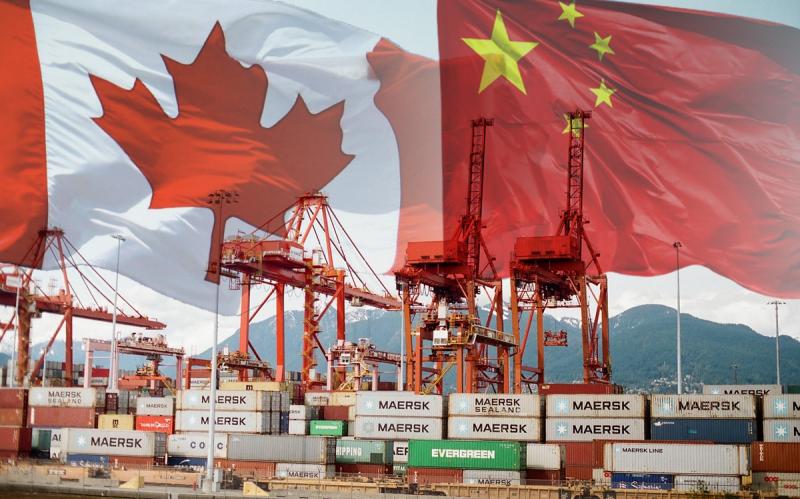
While U.S. policymakers focused on tariffs, threats, and short-term leverage, Canada quietly invested in long-term optionality. The most visible symbol of that shift is the Trans Mountain expansion, an infrastructure project that fundamentally altered Canada’s economic geography. For the first time, Canadian oil is no longer functionally locked into U.S. refineries. It can move west—to Asia.
When oil tankers began departing British Columbia in 2025 bound for China, Singapore, and other Pacific markets, it marked more than a logistical milestone. It signaled a strategic reorientation. Canada was no longer planning its economy around American demand alone.
The numbers are stark.
After U.S. tariffs hit, Canadian exporters lost an estimated $18.5 billion. Conventional wisdom suggested recovery would be slow, painful, and dependent on Washington’s goodwill. Instead, Canada pivoted. By redirecting exports to 27 different trading partners, Canadian firms recovered nearly $11 billion within 18 months. Analysts now estimate that by late 2026 or early 2027, Canada could fully replace the revenue once tied to the U.S. market.
That speed has caught many observers off guard.
Economists note that this was not a spontaneous adjustment. Canadian businesses had spent years preparing alternative supply chains, logistics routes, and customer relationships. Once the pressure came, they were ready to move. What initially looked like crisis management quickly became a blueprint for independence.
Crucially, this shift has changed negotiating dynamics.
As Canada approaches the 2026 KSMA review, it is no longer pleading for relief or carve-outs. Officials are signaling a willingness to negotiate comprehensively—energy, manufacturing, agriculture, technology—on a single table. That posture would have been unthinkable a decade ago. Today, it reflects confidence rooted in diversification.
The impact extends far beyond energy.
Canadian manufacturers are restructuring supply chains to serve multiple continents rather than one dominant buyer. Agricultural exporters are building long-term contracts with Asian and Middle Eastern partners. Ports and rail networks once designed for north-south trade are being reconfigured for east-west flows. The old infrastructure of dependence is being repurposed into an architecture of choice.
This evolution is reshaping perceptions.
For years, Canada was often viewed as an economic extension of the United States—deeply integrated, but ultimately constrained. That image is fading. As trade routes diversify and contracts multiply, Canada increasingly looks like a sovereign economic actor with its own strategic priorities.
The implications for Washington are uncomfortable.
Tariffs lose effectiveness when alternatives exist. Political pressure weakens when dependence declines. And influence erodes when trust is no longer exclusive. Canada has not abandoned the U.S. market—but it has removed the assumption that it has no other options.
Perhaps most striking is how quietly this transformation has occurred.
There have been no confrontational speeches, no dramatic ruptures, no declarations of economic independence. Instead, Canada has executed a steady redirection of trade, capital, and infrastructure. The result is a shift that feels irreversible—not because it was forced, but because it works.
Once businesses learn they can survive—and even thrive—outside a single market, they rarely choose to return to old vulnerabilities.
)
As North American trade continues to evolve, the United States may find itself facing a new reality: a neighbor that is no longer automatically dependent, no longer easily pressured, and no longer content to play a passive role in a shared economic system.
Canada’s quiet revolution is still unfolding. But its direction is clear.
The era of unquestioned American economic dominance over its northern neighbor is fading. In its place is a more balanced, more competitive relationship—one where Canada negotiates not from fear of loss, but from confidence in choice.
And that may be the most consequential shift of all.