In 1969, two University of Texas students who seemed destined for great things were inexplicably killed. Today their loved ones are still haunted and grieving.
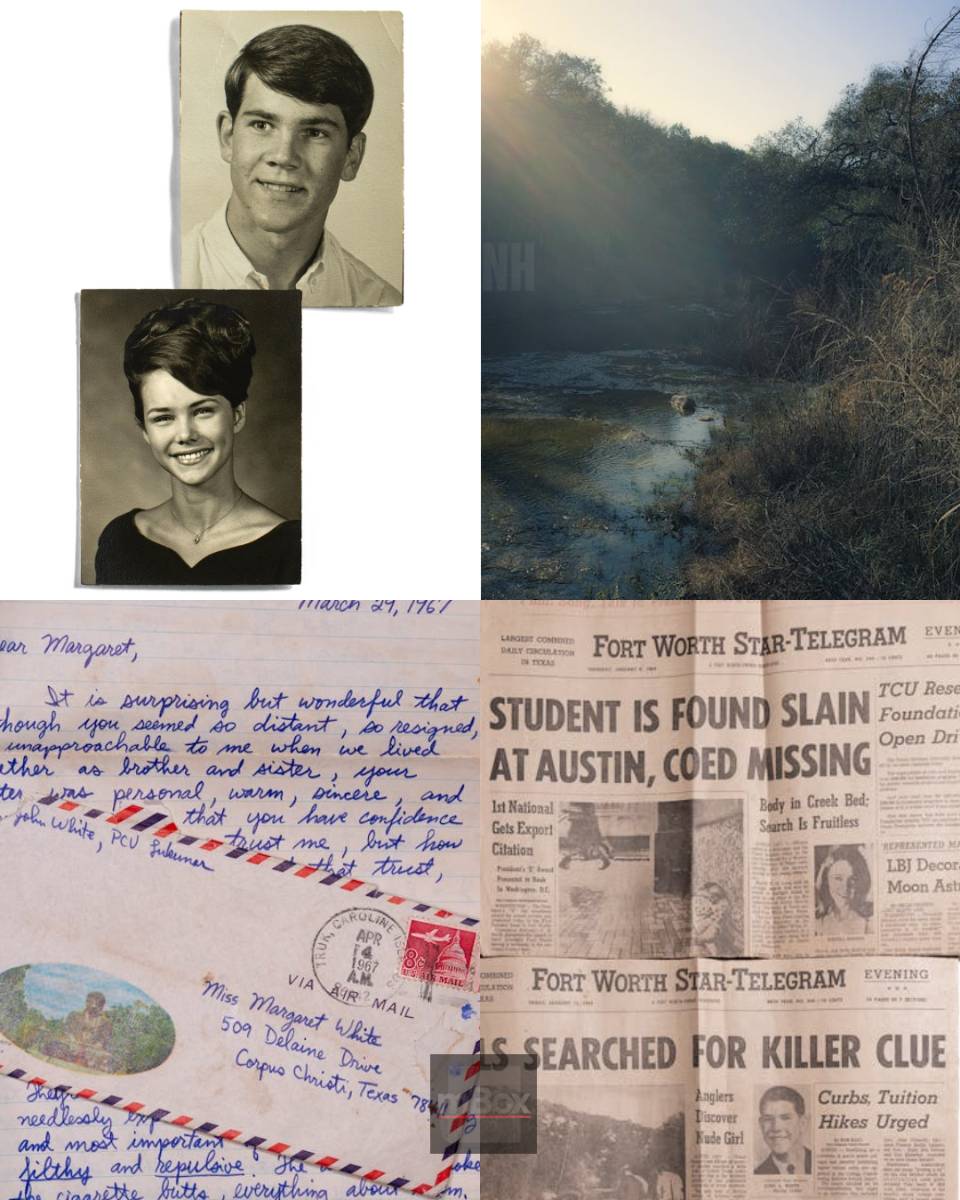 I met John White for the first and only time on an afternoon in December 1968, or perhaps very early in January that next year. I was a junior at the University of Texas at Austin, living with a rotating cast of roommates in an old two-story house on Nueces Street that had been carved up into student apartments. The house was fashionably decrepit, and its stucco exterior was painted a nauseating mustardy shade that had earned it the name the Yellow Bordello.
I lived in a back room whose only decor was a plastic 3D picture above my bed that depicted a little boy and girl on a narrow bridge over a frightening gorge, their guardian angel hovering behind them. The living room I shared with my fellow rent-paying tenants was a common space not just for us but for friends and strangers who would drift in with barely a grunt of hello and help themselves to a space on the floor in front of the turntable, where they would roll joints and listen in stupefied appreciation to Laura Nyro or Jimi Hendrix or the Incredible String Band.
One day, into this den of listlessness stepped John White. He was in the company of mutual friends. What I recall most was how the atmosphere in the room changed. It wasn’t his physical appearance. Newspapers and magazines would soon print a photo of a younger, clean-cut John and stress how handsome he was, but those were the days of long hair and beards and droopy mustaches, and everybody looked pretty much the same on first acquaintance. What was different was the energy John brought with him, the undisguised friendliness, the earnest way he talked that was so distinct from the mumbling, sardonic conversational style the rest of us affected.
He was 21, a year older than I was, and had grown up in the same neighborhood in Corpus Christi as I had. I have no memory of what we talked about—maybe his service in the Peace Corps, which he had just left to enroll in his junior year at UT. Maybe we discussed his pioneering role in bringing surfing to the Texas coast. No doubt the conversation would have turned to Vietnam, which was on all of our minds all the time, and to the impending inauguration of Richard Nixon, whose election John had worked hard to prevent.
All I really remember is that I knew I would remember him, and my assumption was that because we were from the same place and moved in the same circles, he was likely to become a good friend. Since that day at the Yellow Bordello, I’ve often wondered whether my memory of John White is so vivid because of the power of that first impression—or because only a week or so later he was murdered.
 John White as a junior at W. B. Ray High School; Keitha Morris’s White Deer High School graduation photo.Courtesy of Margaret Ellison
The news came through stunned word of mouth—“Did you hear what happened to John White?” Because so few of us had a newspaper subscription or a TV back then, details were scant. We heard only that John had been found, shot to death, at Bull Creek, a shallow stream west of what was at the time the city limit of Austin. He had been on an outing with his new girlfriend, Keitha Morris, a fellow UT student. She too was dead, kidnapped from John’s murder site and found floating a day later in a lake one county over.
This happened less than two weeks into a year that showed every sign of continuing the reign of dark expectancy that had begun with the assassination of John F. Kennedy in Dallas five years before. There was a numb awareness that anything could go wrong, any unthinkable thing could happen. In August 1966 a sniper named Charles Whitman murdered 15 people and wounded 31 from the deck of the UT Tower. Martin Luther King Jr. was killed in April of 1968, Robert F. Kennedy in June. The violent chaos of the Democratic convention in Chicago in August was followed by a presidential election in November that felt like the end of hope and a guarantee that our futures would be suctioned up by the increasingly misguided war in Vietnam.
Maybe it was this mood of fatalism, this saturated sense of doom and futility, that was responsible for blunting my curiosity at the time about what exactly had happened, who had killed John White and Keitha Morris, and why. I’m still puzzled about how somebody who later became a journalist could have remained so passive and uninformed about a crime that was so close to home. But it wasn’t just me. After those first shocked, disbelieving exchanges, I don’t remember anybody in my group of friends talking about the murders again. We just moved on, consigning the crime to the madness of the times.
It was only after Margaret Ellison, one of John White’s sisters, contacted me more than half a century later and asked if I would write about the murders of her brother and Keitha that I began to learn what had happened during those two days in January 1969, and to understand how a tragedy I had come close to forgetting had stamped the lives of multiple families for generations.
I agreed to meet Margaret last summer in Corpus Christi, at the house of a friend of hers in Lamar Park, the neighborhood where Margaret and John and their siblings Mary Sue and Robert had lived when they were children, and where I had lived as well without ever knowing them.
From her current home in Laguna Vista, just across the Laguna Madre from South Padre Island, Margaret had brought newspaper stories about the murders. There were also articles about John’s accomplishments as a surfer and sailor, childhood scrapbooks and photographs, and his letters home from the Truk (now Chuuk) Islands in Micronesia. At nineteen, he had been sent there as a Peace Corps volunteer—one of the youngest ever, Margaret said. It was a lot to sort through, too much: a whole brief, eventful life in a three-gallon Rubbermaid bin.
There was one item that immediately stood out from all the brittle clippings and faded photos. It was a letter on bright orange stationery, written in faded red ink. Margaret told me it was Keitha’s last letter to John, written from her home in White Deer, a farming community in the Panhandle.
Keitha wrote that because of the logistical complications brought on by her sister Kem’s new baby, the family had had to open presents on Christmas Eve rather than on Christmas morning, as they usually did—a break with tradition that she didn’t like—and she complained that she had spent the past four days playing cards with relatives. “I hope you’re having fun surfing,” she told John, who was home in Corpus Christi. “I almost went skiing (snowing) but decided I shouldn’t. (Too expensive and would have missed the last day of the reunion. Just remember when you’re catching that next wave that I’m stuck up here playing hearts (& losing at that).”
It was the sort of letter that any nineteen-year-old college sophomore marooned in her small town over Christmas break, far from the excitement of university life in Austin, might have written to an absent boyfriend. She was clearly restless, ready to move on from White Deer into a different world, into a new life that was supposed to be just beginning but that would come to an end less than two weeks after the letter’s postmark of December 27, 1968.
They had known each other for only a few months. John had introduced himself to Keitha, who was studying 𝒹𝓇𝒶𝓂𝒶, after he saw her perform in a campus political skit. “John told our mother he was crazy about Keitha,” Margaret remembered. “I think he saw that this was the kind of girl he wanted to marry.”
“Keitha was just adorable,” my friend Jenny Roquemore told me recently, as we tried to piece together over lunch our memories of that time. “She was just precious. John was pretty quiet and really nice and kind. A sensitive individual, really caring. He was exceptional.”
Jenny had been friends with the couple for only a few months, but the three had grown close enough for John to ask her to come with him and Keitha and several other friends to a picnic at Bull Creek one January day. Jenny, however, had backed out at the last minute over some now forgotten school assignment. “I don’t have a lot of situations where I remember where exactly people were sitting or standing, but I do with that day. John was to my left, and I was facing College House, the dorm I lived in. Keitha was over here,” she said, gesturing to her right. “It was one of those memories that is really clear. That was when I talked to them about not going, about not being able to go. And then they drove off.”
 Bull Creek, where John was murdered, photographed on February 24, 2025.Photograph by Brian Goldman
The car they drove off in was John’s sporty green Triumph TR4. It was a mild winter day; the temperature was in the seventies. Keitha was dressed in a turtleneck sweater, green corduroy pants, and a serape. John wore a red shirt and white jeans. He also had a top hat, which one of Keitha’s friends told a reporter had been a gag gift for Christmas. It wasn’t John’s style—he “was never a weird dresser,” the friend said—but it was the sort of jaunty, ironic fashion statement that fit in with the Sgt. Pepperness of the times.
Charles Gremminger, a history major who didn’t know John or Keitha, also went to Bull Creek that afternoon. He and another student, B. J. Smith, were on a mission to scout a location for a party. As they drove up Lakewood Drive, they passed a car going in the other direction, a light-colored Volkswagen bug.
Gremminger ended up earning an MBA in addition to his degree in history and spent a career in the real estate title business. He’s retired now, living in the town of Seadrift, on San Antonio Bay. When I visited him there, we talked in the living room of his modern, sunlit house, which was raised up on stilts and overlooked the bay and the marshy terminus of the Guadalupe River. His memories of that day were clear enough for him to begin recalling them in the present tense. “When we park the car,” he said, “we note a late-model sports car, a popular Triumph of that era. It was British racing green, and the top was down. I remember that very well. I can see it.”
He and Smith had been looking for a waterfall they’d been told would be a great place to hold a party because the pool beneath would keep beer cold. They found the falls, but the area was full of broken glass, so they kept exploring along the creek. “We go down some distance—let’s say four hundred yards. We’re up against a cliff, heavy brush on our left, we cut in, found the creek, it looked pretty cool, we looked down to the right, looked up to the left. And that’s when we saw an object lying from the ground into the water. That would have been late afternoon. The shadows weren’t too long yet, but they were getting long. And I said, ‘B.J., I hope that isn’t what I think it might be.’ ”
They backtracked, heading upstream through the brush, until they came closer and found themselves staring across the creek at John White’s body. “I was still hoping that somebody was just playing a joke and had put a mannequin in there,” Gremminger told me. “That’s when I turned to B.J. and said, ‘Do you think it’s a mannequin?’ And B.J. said, ‘Look at his feet. No mannequin is that detailed.’ ”
John’s pants were rolled up, and his feet were bare. He was lying on the limestone bank, his head face down in the shallow water. There was a woven mat nearby saturated with blood. “And that’s when we knew this is a bad scene,” Gremminger said, “This is a really bad scene.”
Today the spot he described lies well within Austin, wedged between freeways and shopping strips and housing developments that ripple out to the horizon on the hills to the west. But back then it was mostly open land, and before the two students could decide on a course of action, they saw a local rancher approaching them on horseback.
When they told the rancher what they had found, he instructed them to stay where they were and said he would go to his house and call the sheriff. The two students nervously watched the man ride off as the sun began to set. “B.J. turned to me and said, ‘How do we know he’s not the guy who did it?’ ”
But after an hour or so, they saw headlights on Lakewood Drive, and soon the crime scene was swarming with investigators. The sheriff and his deputies inspected the blood-stained mat and lifted John’s still-warm body out of the water. They found his top hat lying nearby, as well as an underwater camera his parents had given him for Christmas.
An autopsy later determined that John had been shot in the back of the shoulder by a .38-caliber bullet that had torn through his aorta. But he had still been alive when he landed headfirst in the creek and had “inhaled the mud and water with his last gasp of breath,” according to the medical examiner’s later testimony.
“All we thought we had then was one dead boy,” a deputy sheriff, Billy Webb, told a reporter. “There was no indication anyone had been there with him.”
That understanding changed later that night when Webb visited the Pearl Street house where John lived, to deliver the news that he was dead and to enlist one of John’s roommates to make an identification. That was when Webb learned that one of the roommates, David Bond, and his girlfriend, Dawn Horak, had been at Bull Creek that day with John and Keitha. They had driven in a separate car, hung out with them for much of the afternoon, and then left them alone, perhaps an hour or so before John’s body was found.
So where was Keitha? The deputies went back to the creek with flashlights, searching deep into the night. They found footprints—in an erratic pattern that seemed to indicate someone might have been running—but nothing else to add to their understanding of the crime scene or of where the missing girl might have gone.
Inks Lake, about seventy miles northwest of Austin, is one of a chain of reservoirs along the Colorado River known as the Highland Lakes. It’s much smaller than the lakes upstream and downstream from it, but it’s one of the most scenic, with a state park along its shore where bare shelves of pinkish gneiss (some of the oldest rock in Texas) plunge down to the waterline. The day after John’s murder, on Thursday, January 9, 1969, a couple from Utah who were fishing by the lake saw a battered, unclothed body floating face down in the water only a few feet from where they were standing. They alerted a park caretaker, and the grim duty of pulling Keitha Morris from the water fell to him and a game warden.
A preliminary autopsy that night revealed that Keitha had been strangled. She did not appear to have been sexually assaulted, but she had suffered a broken neck, multiple head injuries and lacerations, and abrasions on the backs of her heels that suggested she had been dragged along some kind of rocky surface. But none of that had been enough to 𝓀𝒾𝓁𝓁 her. She was still alive when she was thrown into the lake, still breathing until she had inhaled water and drowned.
Keitha’s body had not yet been found when John White’s parents in Corpus Christi were notified that their son had been killed. “It was a school night,” Margaret Ellison remembered on our second visit, as we sat in her home in Laguna Vista. I had driven down from Austin to meet her and her sister Mary Sue Gladstone, a retired teacher and Montessori school director, who was visiting from San Diego. We were once again looking through the contents of the Rubbermaid bin.
Margaret had been a senior at W. B. Ray High School when John was killed. Mary Sue, fifteen months younger, was a junior. They were both at home when the phone rang.
“I remember my mother collapsing,” Margaret told me. “Absolutely collapsing.”
“It took a long time to get it out of our parents,” Mary Sue said, referring to the news of her brother’s death. “They were just a mess.”
The house soon filled with friends and relatives. The girls’ high school friends surrounded them and did their naive best to cheer them up, but Margaret and Mary Sue were too numb to react. The next day there were exams at school, and they went back to class as if the spell of normalcy that had once protected them was still in place.
“He just had such a promising life,” Margaret reflected as she and Mary Sue spread out the newspaper clippings and photographs for me on the dining room table. Here were John’s letters home from the Peace Corps. He was writing from almost eight thousand miles away, wondering when a ship would come with mail and supplies of familiar food. “One can live healthily on fish taro and breadfruit,” he reflected, “but just between you and me a hamburger would be heaven on earth.” His diet had narrowed but his thoughts were expanding. “Knowledge is infinite,” he wrote to his parents, “and the truth is unreachable which makes education somewhat like a tiny boat in a stormy and expansive ocean with no anchorage and no visible destination. Its direction is arbitrary and its journey infinite.”
“Surfboard champ” read the caption of one photo from the Corpus Christi Caller-Times that depicted John expertly riding the waves near the Port Aransas jetties during a competition in which he had taken first place over ninety other surfers from up and down the coast. He was one of a handful of people who introduced surfing to Texas, along a stretch of shoreline that had seemed, with its complex wind-and-wave patterns and lack of booming rollers, like an unpromising place for the sport to take root.
“We were there right at the start,” his friend James Dinn, now a retired orthopedic surgeon in Corpus Christi, told me. A friend of theirs named Larry Laws had learned to surf in Hawaii and had come home certain he could make money renting boards and offering lessons. “In order to convince people that you could actually surf in Texas, Larry encouraged John and me to kind of hang around and show people that you could go out and catch a wave and ride it in. So we were the demo guys.”
 A letter from John to his sister Margaret.Photograph by Brian Goldman
Also spread out on the table were the heartbreakingly ordinary documents that had been found in the glove compartment of John’s car after he was murdered: his draft card, a mechanic’s bill for $23.91, a receipt from the UT bursar for his tuition and miscellaneous university fees that added up to $76.00. There was his letter to the editor that had been printed in the Caller-Times, putting forth a sophisticated polling-based argument that Eugene McCarthy, on whose idealistic campaign he had worked, would have a better chance of defeating Richard Nixon than Hubert Humphrey would. And there was the yearbook from his alma mater, Ray High School, where he was the valedictorian of his teeming class of about nine hundred. His commencement address was titled “Education From Within.” He was also runner-up for Mostly Likely to Succeed. In the yearbook was an inscription from the friend and classmate who had been voted Most Beautiful. Her name was Farrah Fawcett. “It’s so rare to find a person with so many wonderful qualities,” she wrote to John. “I’m looking forward to seeing you in the future! Congratulations on your multitude of honors—I wish you all the happiness in the world along with them.”
Lamar Park was a middle-class Corpus neighborhood, and the three-bedroom brick house the Whites lived in was a relatively modest residence for the family of a prominent attorney. Jack White, John’s father, was a partner in a law firm whose members included the mayor. He sat on the board of trustees of the First Baptist Church and of the University of Corpus Christi, served as precinct chairman of the Democratic Party, and was a competitive sailor, a passion that John had shared. His wife Evelyn was, according to Margaret, a “typical housewife of the sixties,” busy at home and with her church, her bridge club, and her other obligations.
John’s funeral took place on Friday, January 10, two days after he died. A day later, 650 miles north, Keitha Morris was remembered by her family and friends at a service in White Deer. The little town of 1,200 essentially shut down for the funeral on the frigid winter afternoon. Streets were empty, shops were closed, and the mourners at the First Methodist Church overflowed from the sanctuary into its meeting rooms and hallways. Afterward, there was a thirty-mile procession to the slightly larger town of Claude, where Keitha’s grandparents owned the main business, a grain company, and where many of her ancestors were buried.
Like John White, Keitha came from a family of four children—two boys and two girls—that was known and respected in its corner of Texas. The family’s grain elevator in Claude was not just a storage facility but a kind of community center. Keitha’s mother’s family, the Bagwells, had lived in the Panhandle since the days of Quanah Parker and Charles Goodnight. One relative told me that Goodnight himself had given the family a pair of beaded moccasins when Keitha’s mother was born in 1913.
Keitha’s father, John Morris, was the principal of White Deer’s elementary school. Her mother, Edith, was a teacher in the same school and had grown up in a large family of college graduates. “Education reigned in the Bagwell family,” Keitha’s niece Lynette Berg Robe told me. “Keitha was beautiful, but she had 𝓈𝓊𝒷𝓈𝓉𝒶𝓃𝒸𝑒, and she came from a family that valued intellect and industriousness.”
In high school, Keitha was a swimmer, dancer, all-district basketball player, and choreographer of student plays and water ballets. But what exerted the strongest pull on her was acting. She won best actress in both district and regional contests and majored in 𝒹𝓇𝒶𝓂𝒶 when she entered UT. To her suite mates at Madison House, the private dorm where she lived, she was “a very vibrant, happy person” who worked hard and never missed a play rehearsal. “She was so trusting,” one of them remarked to a newspaper reporter at the time of her death, “perhaps too trusting sometimes. She never thought that someone might want to harm her.”
 From left to right: John with his sister Mary Sue outside their family home in Corpus in summer 1968; John at Padre Island beach during his middle school years; John as a student at Moses Menger Elementary School, in Corpus Christi; John in his TR4 outside his home in Corpus Christi; Keitha, circa 1968.Courtesy of Margaret Ellison
On January 26, 1968, almost a year before the murders of John and Keitha, a troubled engineering student presented himself to a psychiatrist at the UT student health center. It was the same facility Charles Whitman had visited in March 1966, when he had confessed to a different doctor a fantasy of “going up on the Tower with a deer rifle and shooting people.” Clyde Durbin Jr. made no such threats, but Dr. Erwin Taboada, the psychiatrist who evaluated him, was deeply concerned. Durbin was twenty years old. He was sleeping all the time, worried about being drafted, irritated by sounds, on the verge of dropping out of school, and frustrated at being unable “to think of adequate words.”
Durbin flunked out of school, though he got a job that summer as a technician at the university’s Center for Nuclear Studies. Before he started work, he continued to see Dr. Taboada, now at the state hospital, who prescribed an antipsychotic, but after several weeks as an outpatient, he stopped going. He still lived near the campus with three roommates in a two-bedroom apartment on San Jacinto Street, where his share of the rent was $43.75 a month. His roommates regarded him as quiet and well-mannered. They had never heard him use a curse word.
Durbin’s great-grandfather had been a famous Texas Ranger. His father, Clyde Durbin Sr., had an unpromising start in life and grew up in a widow’s and orphan’s home in Corsicana. But he became an Eagle Scout, served in the merchant marine in World War II, and led a successful Dallas company that made pressurized alloy containers for uses such as chemical storage and rocket testing.
Mental illness seemed to stretch deep in the family. A psychiatrist would later testify that Durbin’s mother, grandmother, and great-grandmother had all suffered from schizophrenia and likened his confused, conflicted mind to a “photographic plate that has been double 𝓮𝔁𝓹𝓸𝓼𝓮𝓭.”
When Durbin returned home on the night of January 8 or the early morning of January 9, he seemed to be normal, according to one of the students with whom he shared the apartment. He listened to music on his stereo and went to bed. When news of the murders came out, he bantered with his roommates about needing an alibi, since they knew he had been out at Bull Creek that afternoon. But anxiety and fatalism were surging beneath his placid affect. “I decided,” he later told a psychiatrist, “I’d just sit back and let them come to me.”
Sheriff’s deputies came to him eight days later, after a period of frenetic activity that involved examining photographs of the Bull Creek area that had been taken from an Air Force reconnaissance plane, pursuing various false leads, and interviewing potential witnesses. There had been film in the underwater camera that had been found near John’s body. When it was developed, it turned out not to be crucial to the investigation, but the photos—taken by the couple who had met John and Keitha at Bull Creek and were the last people other than their assailant to see them—depicted some of the last moments of their lives. A few showed Keitha sitting on the limestone creek bank, staring quietly out at the water or grinning upward at the camera with her arms outstretched on shelves of rock. One of the photos was a close-up of John and Keitha kissing. Not at all salacious, but private. The White and Morris families were outraged when the photos were 𝓵𝓮𝓪𝓴𝓮𝓭 to the press and apparently sold to the tabloid magazines of the time, which made lurid use of them. The cover headline of Front Page Detective, for instance, was “Their Last Kiss Before Dying.”
The pieces of the investigation began to fall into place after John Allen Wilbern, an employee of the Lower Colorado River Authority at Buchanan Dam, which forms Inks Lake, reported that he had seen the taillights of a car from his lakefront home on the night of Keitha Morris’s murder. Worried that someone had steered into a ditch, he drove over to investigate and saw a tan Volkswagen—like the one that Charles Gremminger and B. J. Smith had seen earlier that day when they were en route to Bull Creek to find a place to hold their party—parked by the side of the road. There was no one in the car, but the dome light was on, and as Wilbern approached, Durbin, from somewhere in the dark, reportedly warned him, “Don’t come over. She’s not dressed.”
Wilbern backed off. When he was about a hundred yards away, he heard what he thought was a female voice groaning. The next morning, he went back and found a shoe that turned out to belong to Keitha Morris.
Then an Austin gun dealer reported a curious occurrence. A young man to whom he had sold a .38-caliber pistol on January 4 had returned to the store five days later, “scratched up and limping,” and complained that the gun wasn’t working properly. The dealer replaced it, but the man later returned and was given a refund. The crime, and the search for a tan Volkswagen—the same kind of car the disgruntled customer was driving—was front-page news by then, and the dealer contacted the Travis County sheriff’s department. The name of the man he had sold the pistol to was Clyde Durbin Jr.
Durbin was compliant on the Thursday morning when the deputy sheriffs knocked on his apartment door and asked him to come to the courthouse for questioning. He even led them to a culvert near a drive-in movie theater in Austin where he had hidden Keitha’s bloody clothes. They searched his car and found bloodstains, as well as hair and gravel. He was cooperative, occasionally emotional, sometimes crying. For 21 hours he was without counsel while he was alternately courted by lawmen and badgered by them—“Do you remember her naked body, Clyde? Did you feel her naked body?” By the end of an exhausting and bewildering interrogation, he had confessed on 𝓉𝒶𝓅𝑒 and in a seven-page handwritten document.
 The Fort Worth Star-Telegram’s coverage of the murders.Photograph by Brian Goldman
Durbin went to trial first in Austin for the murder of John White, with a separate trial planned in Burnet County for Keitha’s killing. But the two homicides were deeply intertwined and details of both surfaced during weeks of legal proceedings. It was a time when not only was jury selection covered in the newspapers but potential jurors were named, their addresses published, and their physical appearance assessed in print: “Mrs. Chapman, of 4809 Shoalcreek . . . was tanned and pretty with long blonde hair and glasses. She wore a bright flower print dress.”
Keitha, the victim, had already been subjected in death to something of the same leering scrutiny: the “comely Miss Morris,” the “pretty vibrant coed,” “The brunette” who . . . “didn’t know that before this lovely day was finished she wouldn’t be wearing any clothes—she would be 𝓷𝓾𝓭𝓮 and dead . . . ”
There was nothing salacious in the defendant’s courtroom comportment. He sat impassively each day throughout the proceedings in the 147th District Court with his arms folded. He was six feet tall, thin, bearing the scars of adolescent acne.
Durbin’s lead attorney, Frank Maloney, did his best to convince the jury that his client had been insane at the time of the murders. Maloney put four psychiatrists on the stand to testify about Durbin’s family history of schizophrenia and his “uncanny” detachment from reality. The written and taped confessions Durbin had given, the defense argued, were the result of hours of ceaseless interrogation pressure on a frightened young man who, in an addled attempt at cooperation, had waived his right to a lawyer.
But the judge ruled the confessions admissible, and the courtroom heard the 𝓉𝒶𝓅𝑒 of Clyde Durbin Jr. speaking to investigators in a low, whispery voice with long stretches of silence. “I hit him . . . hit him again . . . didn’t work . . . hit him with rock . . . and . . . he started to fight . . . she . . . ran . . . he had me down . . . shot. . . She asked . . . me . . . not to 𝓀𝒾𝓁𝓁 her.”
“I could not do something like this,” Durbin told sheriff’s deputies in a second recording. “I couldn’t have planned something like this. Something went wrong.”
“Something went wrong.” That sentence was as close as anyone would ever come to explaining a seemingly motiveless crime. Keitha Morris had been beaten and strangled, but not sexually molested. John White had been hit over the head and shot through the heart for no apparent reason. There was only one witness to the murders, and that was Clyde Durbin Jr., whose firsthand testimony was vividly set down in the confession that he had written while in custody, and which was read aloud to the jury during the trial.
Durbin wrote that at 3:30 p.m. on January 8, 1969, he drove his Volkswagen to Lakewood Drive, the road that ran along Bull Creek. He had an interest in hiking, and on this afternoon he was climbing a cliff above Bull Creek, looking for caves. From the top of the cliff, he saw a half dozen or more people by the creek and John’s green Triumph and two other cars parked near the falls. He drove home to his apartment and picked up “my 38 cal. Rohm pistol (for no reason)” and returned to Bull Creek. He had brought some rags from his apartment and wrapped his pistol in them, then “walked back along the creek toward the third crossing and saw a couple lying on a mat.”
“Before this time I had never seen, met or heard of Keitha Morris or John White . . . [I] showed the gun and told them to lie still, with hand outreached. John asked, ‘What’s going on?’ ”
“It’s hard to remember but something was said about robbery by myself or John. He did not carry a wallet, but he had some small change which he pulled out and which I did not touch. I noticed a camera and a top hat neither of which I touched and then I told them I would have to escape and I would knock them out.”
He wrote that he hit John with his pistol butt and then with a rock, but John was still conscious and grabbed at him. “Keitha ran, the gun went off, and John fell aside . . . he made a strange noise and then was quiet.”
He wrote that Keitha got into his car with him because she was afraid he would 𝓀𝒾𝓁𝓁 her if she didn’t. “I told her that I would let her out in the country away from any town. We talked as I drove, about 𝒹𝓇𝒶𝓂𝒶, movies and art.”
Keitha must have desperately wanted to believe Durbin was not planning to 𝓀𝒾𝓁𝓁 her as she engaged in his attempts to make casual conversation. When they got to Inks Lake in the darkness, he tied her to a tree, and she tried to convince him that if he let her go, she would tell everyone that she “had been knocked out and hadn’t seen anything.” That was when John Allen Wilbern came upon the empty car with its dome light on, and when Durbin told him to go away. After that, Durbin wrote, “Keitha became very frightened about my shooting her and I couldn’t convience [sic] her that I wouldn’t shoot her.”
She had managed to untie her hands and tried to grab the gun, he claimed, but after a struggle, he forced her back into the car and drove down another dirt road, where he tried to tie her up again. She got loose and ran away, but he 𝒄𝒂𝓊𝓰𝒉𝓉 her, beating her and choking her by pressing down on her throat with his elbow until she passed out. When she came to, he grabbed her again, but “I couldn’t 𝓀𝒾𝓁𝓁 her by strangulation so I put her in the car and drove to the edge of the lake.” He removed what remained of her clothing and then “I tried to carry her to the water and couldn’t so finally I 𝒹𝓇𝓊𝑔 [her] to the lake and pushed her in.”
The trial lasted two weeks, and after four hours of intense deliberation, the jurors came back with a verdict: Durbin was both sane and guilty of the murder of John Albert White. He was sentenced to 99 years in state prison.
His expected next trial, for the killing of Keitha Morris, never happened. Instead, he accepted a deal between his lawyers and Burnet County prosecutors in which he would accept another 99-year sentence and agree not to appeal either case. In return, the prosecutors would not seek the death penalty for Keitha’s murder and pledged not to protest when Durbin came up for parole, which might have been in as few as ten years.
But it was an oral agreement, never written down, and by 1982, when Durbin began applying for parole, the new occupants of the Travis County district attorney’s office said they knew nothing about it. They contested his parole on multiple occasions until David Botsford, Durbin’s new attorney, filed a writ of habeas corpus in 1995 that brought the plea arrangement back to the attention of the Burnet County district court.
It was a technicality that led, 35 years after his convictions, to Clyde Durbin Jr. being released. During his incarceration he had lived in six different units of the Texas prison system, earning a college degree, doing “extremely well,” as one member of the Board of Pardons and Paroles wrote in 1985. The families of John White and Keitha Morris lobbied hard against his parole every time it became a possibility, but in the end they couldn’t prevail against the opinion of U.S. District Judge Sam Sparks, who ruled in 2002 that in part because of the broken promise of the prosecutors not to protest Durbin’s parole, he had suffered an “unconstitutional conviction” in Keitha’s case. By that time he had received enough credit for good behavior and time served for his 99-year sentence for killing John White to be formally discharged, and he was granted a new trial in Burnet County for the death of Keitha Morris.
During the decades Durbin was in prison, John White’s brother, Robert, who had barricaded himself in the UT Tower in 1966 during Charles Whitman’s shooting rampage, died in 1985 at 44. The burial plots that Jack and Evelyn White had bought for themselves at Seaside Memorial Park in Corpus Christi were given over to the remains of their two sons. John Morris, Keitha’s father, died in 1988, after a stroke. And his wife, Edith, had passed away long before, in 1973, at 60, only four years after her daughter’s murder.
“She lay down for a nap on the couch,” Keitha’s niece Tara Norbeck, a retired nurse who lives in Houston, told me. She never woke up. “I was only a child at the time. But as an RN, I was a heart failure coordinator. There’s something called broken heart syndrome. That’s a real medical diagnosis. It’s also called Takotsubo syndrome. I’m convinced that’s what killed my grandmother.”
When Clyde Durbin Jr. entered the Burnet County courthouse in August 2004 for his long-delayed legal reckoning for Keitha Morris’s murder, the resolution of his case was brisk. The judicial rationale for spending taxpayer money on a lengthy new trial was faint—especially given that some of the witnesses were dead and the court reporter’s notes had disappeared. Instead, Durbin, now 57, essentially pleaded guilty, was sentenced to time served, and walked out of the courtroom to live with his family in Dallas.
 Inks Lake State Park.Photograph by Brian Goldman
On a morning in late May, I drove up Lakewood Drive in Austin along Bull Creek. Using a sketchy map Charles Gremminger had drawn from memory in my notebook, and directional insights I had gleaned from various old newspaper articles and photographs, I set out on a city hiking trail. After a mile or so of walking on the path that led below the cliffs Durbin had been exploring that day, I bushwhacked down to the creek. The water was shallow and clear, and the limestone creek bed was slightly broken and uplifted in a way that created miniature rills and falls whose sounds were audible above the traffic noise. After a few hundred yards, I found the place where, I calculated, Durbin had come across John White and Keitha Morris. I recognized, or at least thought I recognized from a 1969 newspaper photo, a rocky bank that jutted out a few feet into the creek. That could very well have been where John’s body had fallen, next to his picnic mat, his gag-gift top hat, his underwater camera. Even though the city of Austin had erupted all around this spot, it still felt hidden away and isolated—although knowing what I knew, I could never again think of it as peaceful.
That afternoon I drove northwest, following the route Durbin took after he abducted Keitha. Texas Highway 29 west of the town of Burnet winds through a particularly scenic stretch of Central Texas, full of rolling hills and granite outcroppings before veering off toward the picturesque rocky shores of Inks Lake. But it had been night back in 1969; there had been no scenery, only the road ahead in the headlights leading nowhere that Keitha could comprehend as she apparently tried to placate Durbin by talking about movies and art. I drove down two dirt roads on either side of the state park, getting out of my car to follow footpaths that I thought might lead to the places where Keitha had been terrorized and murdered.
But after a few more minutes of searching, I turned around and walked back to my car. By then my reporter’s curiosity was beginning to feel like an obscene affront to her memory, too much like the tabloid accounts of the murder that I saw a few weeks later at the Austin home of Inelle Bagwell, the widow of Keitha’s uncle Don. Like Margaret Ellison, Inelle had a box of mementos and clippings of the “bright shining star” that her family had lost.
“She was so warm, so incredibly friendly,” Inelle said as we gathered around the table with a group of family members, including her children, Linda, who works in the nonprofit sector, and Gary, a petroleum engineer. They are two of the nineteen cousins in Keitha’s generation. Inelle remembered seeing Keitha for the last time when she had driven over with her parents from White Deer to a big family Christmas gathering in Claude. It was the same Christmas break when Keitha had written to John complaining about being stuck in the Panhandle playing hearts.
Gary was ten when Keitha died; Linda was six. Neither remembered the moment when they were told about her death, but in Linda’s case, there was a delayed reaction. When she was sixteen, she was looking through a cabinet in her family’s house in Claude when she came across some of the old tabloids with articles about the murders. One of the magazines had reprinted Durbin’s confession, and that was the first time she read about the horrible hours that Keitha had endured after John’s shooting.
Ever since, she said, “I wouldn’t say that Keitha’s death was always at the front of my mind, but her death has a cycle; it has a story arc that you’re not in control of, and every now and then it’s in the spotlight again.”
A version of that fear hovered over Keitha’s niece Tara Norbeck for much of her life as well. “I remember from a very early age,” she told me over the phone, “my parents sitting me down and saying, ‘There are bad people out there, and they will take you away and they will hurt you.’ When I was in high school and about to go to college, I was thinking about applying to UT, and my mom pulled me aside and said, ‘You cannot go there. It’ll 𝓀𝒾𝓁𝓁 your dad. You cannot go there.’ ”
“Keitha’s murder has affected me to this day,” she said. “I went to get the mail in the golf cart thirty minutes ago, and there are people out there and I immediately watch my back, making sure they don’t follow me to the house. My husband will be out mowing the yard and I’ll lock the doors.”
I met Kurt Lester, one of Keitha’s nephews, at a coffee shop in Amarillo. He’s 54 and looks like the high school football coach he used to be, before he went to work as a facility manager for Pantex, the country’s primary plant for the assembly and maintenance of nuclear weapons. “A lot of kids grow up with stranger danger and whatnot,” he said. “But we hundred-percent knew there really were evil people in the world, because Keitha was murdered and gone. It’s an odd thing to grow up with as a child.”
He was born two years after Keitha died. His mother, Keitha’s sister Kem, who died in 2016, had fought for years against Durbin’s parole. Kurt was with her, along with Tara and other family members, during his court appearance in Burnet County in 2004. Some in the Morris and White families seemed open to the idea that Durbin had suffered from mental illness when he committed the murders, but Kurt could not help seeing him as an agent of evil, someone whose potential release must be regarded with dread. “To me, he had that look of Jeffrey Dahmer, a stare-right-through-you type personality. And I can still remember watching my mom. That was one of the hardest things I’ve had to do as an adult, is sit there and watch my mom be in that much anguish.”
Of course, I wondered about Clyde Durbin Jr. and what he might understand—now that he was well into his seventies—about what he had done and why he had done it on that January day in 1969. Did he consider himself guilty of the deaths of John and Keitha? Did he have any comprehension of what had motivated him? Had a confused, lonely, mentally troubled kid gazing down from the summit of a cliff been seized with such resentment and envy at the sight of a beautiful young couple that he had driven all the way home to get his pistol—“for no reason”—and then driven all the way back and hiked up the creek to confront them somehow—to rob them? To 𝓀𝒾𝓁𝓁 them?
I emailed and texted Clyde Durbin Jr. I told him that his taped comment to the deputy sheriff that had been heard in court—“Something went wrong”—had haunted me since I began working on this story. “I’m about the same age that you are,” I told him. “We share some of the same generational experiences, and perhaps to a degree the same sense of bewilderment at looking back on our lives and thinking how distant we are from the people we were then.”
He didn’t reply, nor did a member of his family whom I also contacted. Fair enough, I thought. I wasn’t going to show up at his door or accost him on the street to ask questions that I was pretty sure would have no real answers and therefore no value to anyone, especially to the families—three generations deep now—of John White and Keitha Morris.
White Deer is forty miles northeast of Amarillo. It has about as many residents now as it had when Keitha lived there in the sixties. In my brief tour of the little wheat-farming town, I encountered only a few cars, and I was the only pedestrian wandering down Main Street past its mostly deserted storefronts. But I had a good feeling about White Deer. It felt like it might have been an okay place to grow up, secure to a lively, friendly girl like Keitha who wanted to know everyone, mildly stifling when she was old enough to want to leave and explore a wider world.
Claude, thirty miles away, where the Bagwell grain elevator (now owned by an Amarillo company) reared up over the train tracks and where the extended family gathered for holidays and celebrations, and where many of them are buried, is only marginally bigger. It was such an exemplar of a dust-blown Texas town that Hud was filmed there in 1962, and it’s a fair bet that, as a thirteen-year-old aspiring actress, Keitha Morris had been one of the bystanders eager to catch a glimpse of Paul Newman or Patricia Neal and to learn about how a movie was made.
I drove with Kurt Lester to the Claude Cemetery, just outside of town. It was an island of grass in a sea of brown wheat fields. Mockingbirds and meadowlarks darted and dipped among the tombstones, and wind turbines churned away on the horizon. We stood over the grave of Keitha Jane Morris. “May 2, 1949–Jan. 8, 1969. Forever in Our Hearts.”
Kurt said he and his wife had named their daughter after her. She grew up with a photo of Keitha in her room. Kurt oversees a fund created in Keitha’s honor that, every year, provides a scholarship to a local student.
For many years, Kurt’s mother owned a successful bed-and-bath shop in Amarillo. “I worked in that store also for twenty years,” he said. “There were people we didn’t know from Childress or Clarendon, these small Panhandle communities, who would come in to shop and tell my mother that they named their daughters after Keitha.”
Weeks earlier I had been standing with Margaret Ellison over her brother’s grave in Corpus Christi, in a cemetery that is now a pilgrimage site because it is also the resting place of the Tejano singer Selena. John’s gravestone, like Keitha’s, is a bit weathered. Into it are etched the words “Blessed Are the Peacemakers,” an image of a flying dove, and—in further homage to his work in the Peace Corps and his attempts to elect Eugene McCarthy and end the Vietnam War—the peace symbol you used to see everywhere in those jittery times.
The two tombstones are far apart, at opposite ends of Texas, but the young people lying beneath them had been united, for a month or so at least, in youthful infatuation, maybe even in love, certainly in the glow of possibility that comes with a new romance.
Standing here in the Claude Cemetery, looking down at Keitha’s grave, I thought of all the terror these two young people had endured and of all the life they had been denied as my own future had rolled on for more than fifty years with barely a substantive glance backward at their fate. I remembered again the first and only time I had met John, and how he had shaken up the stultifying, dope-hazed, going-nowhere vibe of the Yellow Bordello with his eager, earnest, engaged presence. And then I remembered the picture on my bedroom wall, that cheap 3D novelty image of an angel watching over two children on a bridge. Like John’s top hat, it had been a joke purchase, a nod to something—guardian angels—whose existence was a discarded fantasy of childhood. But I had hung it over my bed anyway, ready to be soothed by it even in my ironic detachment. There had been a part of me that was still warmly open to the idea that this boy and girl would not fall into the raging river below. That wanted to believe with them, in their innocence, that they would be forever safe.