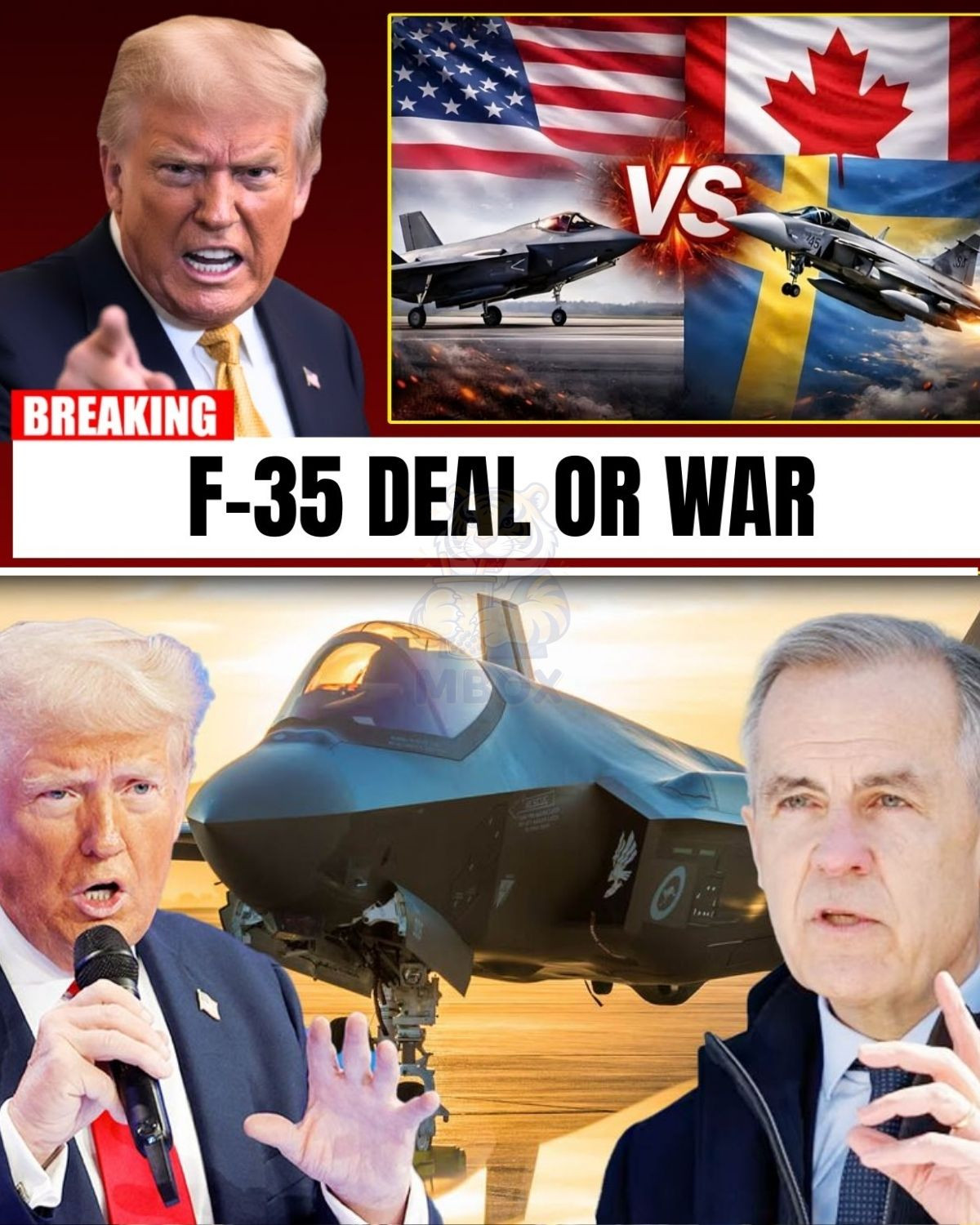
 A diplomatic crisis has erupted between Washington and Ottawa over a multi-billion dollar fighter jet contract, with the U.S. Ambassador explicitly threatening Canada’s economic future if it abandons the F-35 program. The stark ultimatum, delivered at the Munich Security Conference, has ignited a fierce debate in Canada about national sovereignty and defense independence.
 Prime Minister Mark Carney’s government is actively reconsidering its commitment to purchase 16 F-35s from Lockheed Martin. This review follows the arrival of a competing, transformative offer from Sweden’s Saab, centered on its Gripen E fighter. The Swedish proposal promises full technology transfer and domestic production.
Ambassador Pete Hoekstra’s warning was unambiguous. He stated that walking away from the F-35 would mean Canada should “forget about” any future trade agreement with the United States. This hardline stance has been widely condemned in Canadian political circles as diplomatic blackmail, escalating a procurement decision into a test of alliance loyalty.
The Swedish alternative, presented by the King and Queen of Sweden alongside Saab’s chairman, stands in direct contrast. It offers Canada not just jets, but a sovereign aerospace capability. The plan includes building a final assembly line in Canada, creating up to 10,000 high-skilled jobs, and enabling exports to allied nations.
Defense analysts note the core distinction: with the F-35, Canada remains a perpetual customer. With the Gripen, it becomes a manufacturing partner and owner. This difference highlights the central question of whether Canada controls its own defense assets or accepts permanent foreign oversight.
Serious concerns about the F-35’s operational readiness are fueling the reconsideration. During a recent U.S. Senate hearing, Senator Roger Wicker acknowledged that many F-35s are frequently grounded, with readiness rates falling far short of promises. This admission from an American official carries significant weight.
A U.S. Government Accountability Office report details deeper problems, noting maintenance and repair costs have exceeded projections by $6 billion. Timelines for crucial upgrades have slipped by at least five years, raising doubts about the platform’s long-term reliability and cost predictability.
The most critical issue, however, is control. The United States retains ownership of all core F-35 software and systems through the Autonomic Logistics Information System (ALIS). Canada cannot independently upgrade, modify, or fully maintain the aircraft without U.S. approval for every part and software patch.
This dependency creates a stark vulnerability. If Washington ever delayed updates or restricted spare parts for political reasons, Canada’s entire fleet could be rendered inoperable without a single shot being fired. The software architecture allows the U.S. to monitor and manage every F-35 globally.
A real-world precedent underscores this risk. In March, Danish lawmakers discovered the U.S. had removed parts from Denmark’s F-35s and transferred them to Israel without prior consultation. Copenhagen had no recourse, contradicting its own foreign policy.
Danish MP Rasmus Jarlov, a former purchase supporter, expressed profound regret, stating they had not bought jets but merely “leased” them with Washington holding the keys. This incident is seen as a direct consequence of the F-35’s controlled ecosystem.
The debate in Canada has been shaped by surprising reversals from military figures. Retired Lieutenant-General André Deschamps, once a leading advocate for Canada’s F-35 involvement, now publicly urges cancelling the contract. He cites sovereign control as the paramount issue.
Deschamps specifically references the political risk under a U.S. administration like Donald Trump’s, which has openly mused about annexing Canada. Trusting long-term, unfettered access to the aircraft’s essential systems is, in his view, an untenable gamble on American politics.
Another voice, retired General Tom Lawson, cautioned against operating two fighter types. This argument was quickly scrutinized when it emerged Lawson spent six years as a consultant for Lockheed Martin, raising questions about the impartiality of such warnings.
The Gripen E is engineered for operational conditions that mirror Canada’s needs, particularly in the Arctic. Designed to operate from short, austere runways and highways, it withstands extreme cold better than the carrier-optimized F-35, according to Swedish and NATO exercise data.
Cost comparisons reveal another dramatic divide. Lockheed Martin promotes a unit flyaway cost near $85 million, but lifetime expenses are colossal. Canada’s Auditor General estimates operating 88 F-35s over 30 years could reach $50 billion, excluding future U.S.-mandated price hikes.
Flight hour costs are particularly revealing. The F-35 costs between $35,000 and $47,000 per flight hour. Data from NATO exercises shows the Gripen E averages approximately $8,000 per flight hour, offering a five-to-one operational cost advantage.
Auditor General Karen Hogan has flagged additional hidden F-35 costs, including hundreds of millions to redesign hangars at Cold Lake and Bagotville bases to accommodate the aircraft’s unique maintenance needs, pushing full operational capability toward 2031.
Under the Gripen plan, investment stays in Canada. Saab’s offer includes complete technology transfer, meaning Canada would own the source code and could perform upgrades and maintenance independently, without seeking permission from Stockholm or using an ALIS-style system.
This concept, termed “sovereign sustainment” by European defense experts, is built into the Gripen’s design philosophy. Sweden developed it during the Cold War to ensure political independence through technological autonomy, a principle that now resonates deeply in Ottawa.
The U.S. ambassador’s threat fundamentally shifts the narrative. It frames the choice not as a procurement assessment but as a loyalty test with severe economic consequences. This pressure tactic has galvanized opposition and amplified sovereignty concerns across the political spectrum.
Prime Minister Carney has stated his duty is to choose what is best for Canada, not for Washington or Lockheed Martin. The funding is allocated; the decision is now strategic. It pits immediate alliance pressure against long-term industrial and defensive autonomy.
The outcome will signal whether Canada believes a nation can outsource its fundamental defense capabilities and retain true sovereignty. The choice echoes beyond military hardware, defining how Ottawa navigates its relationship with a dominant and increasingly transactional ally.
If Canada proceeds with the F-35, it accepts a role as a dependent client state within a U.S.-controlled system. If it selects the Gripen, it embraces a path of sovereign capability, accepting short-term diplomatic friction for long-term control of its national defense.
The coming weeks will determine more than the future of the Royal Canadian Air Force. They will define Canada’s strategic posture for a generation, testing its resolve to make independent choices in an era of great power pressure and economic coercion.