Canada is undergoing a profound shift in how it thinks about national security. As former U.S. President Donald Trump reasserts a transactional approach to alliances and global power, longtime assumptions about stability are collapsing. Former Bank of Canada Governor Mark Carney is now urging a sober reassessment of Canada’s military readiness, warning that goodwill alone can no longer guarantee sovereignty. From economic leverage to Arctic vulnerability, Ottawa is confronting uncomfortable truths about its exposure in an increasingly unpredictable world—and preparing for a future where strength, not sentiment, defines security.

For much of the modern era, Canada’s defense posture rested on a simple belief: alliances endure, rules matter, and geography offers protection. That belief is now being challenged at its core.
Donald Trump’s reemergence on the global stage has acted as a stress test for those assumptions. His record—treating alliances as negotiable, trade as leverage, and loyalty as conditional—has unsettled policymakers far beyond Washington. For Canada, whose security and economy are deeply intertwined with the United States, the implications are uniquely acute.
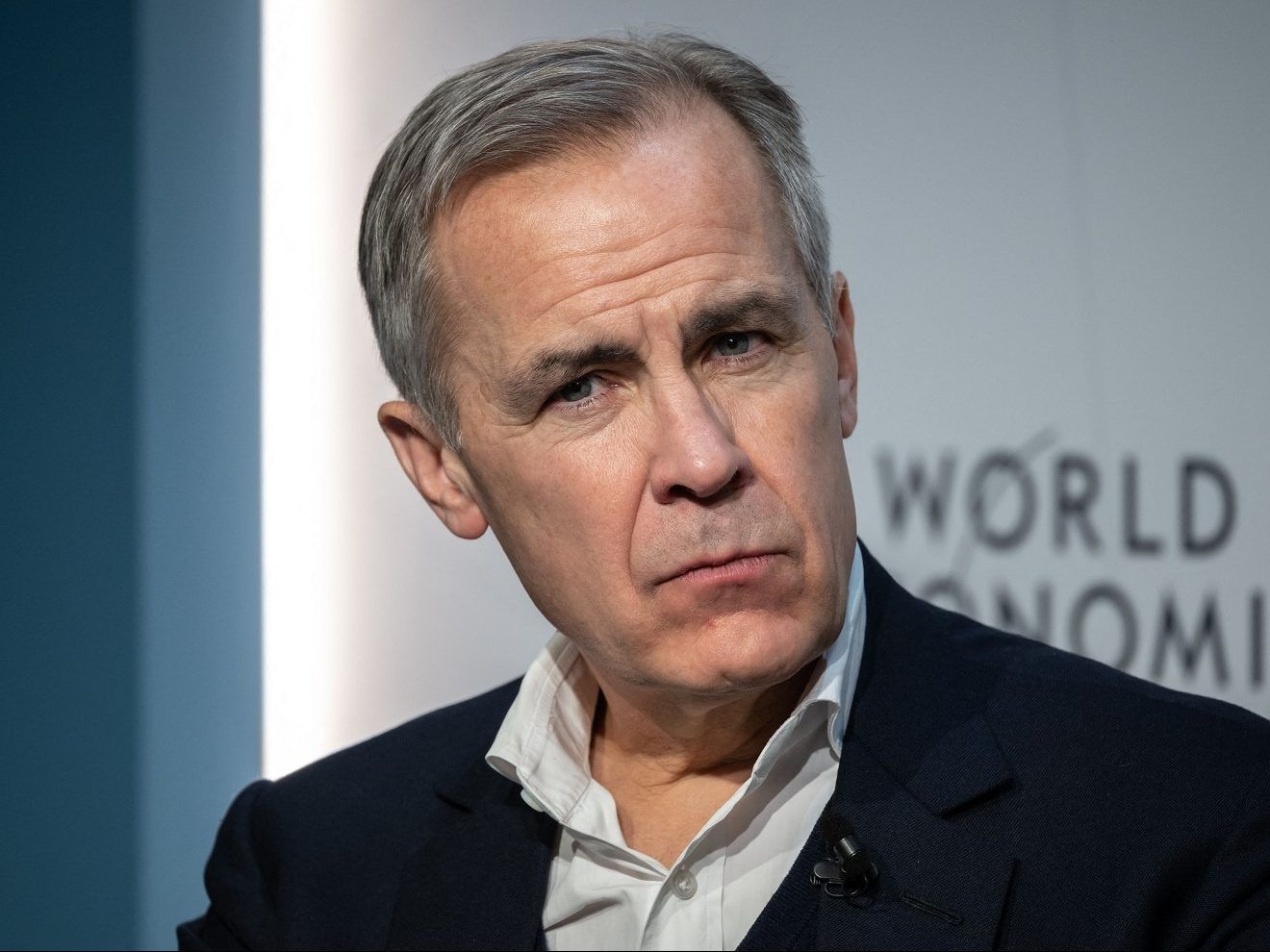
Mark Carney’s intervention reflects a growing consensus among Canadian strategists that the old playbook is no longer sufficient. His message is not ideological or partisan. It is pragmatic: when international relations become transactional, vulnerability grows—especially for middle powers dependent on stable rules.
Trump’s approach has forced Ottawa to confront a reality long avoided. Canada’s proximity to the United States has been a strategic asset, but it also creates exposure. When trade agreements can be threatened overnight, when economic pressure becomes a negotiating tool, and when alliances are framed as favors rather than commitments, Canada’s margin for complacency disappears.
Security analysts argue that this shift transforms economic dependence into a strategic liability. Canada’s export-driven economy, its integrated supply chains, and its reliance on cross-border goodwill leave it vulnerable to pressure that does not involve troops or missiles—but can be just as destabilizing.
That vulnerability is now shaping defense thinking.
One of the most urgent flashpoints is the Arctic. Long treated as remote and benign, the region is rapidly becoming central to global competition. Climate change is opening shipping lanes, exposing resources, and drawing attention from major powers, including Russia and China. What was once frozen insulation is now a contested frontier.
Canada’s challenge is stark: it claims sovereignty over vast northern territories but lacks the capability to consistently project presence there. Infrastructure is sparse. Response times are slow. And crucially, Canada lacks amphibious landing capabilities—assets that allow forces to operate, sustain themselves, and respond rapidly in austere environments.
Carney and defense planners see this gap as more than technical. It is strategic.
Without credible Arctic mobility, Canada risks being a spectator in its own territory. The absence of capability creates an invitation—not for invasion, but for pressure, testing, and erosion of control. In an era where power is often asserted incrementally, weakness does not need to be exploited aggressively to be consequential.
Military modernization efforts now underway are designed to close that gap. An Arctic-capable amphibious platform would allow Canada to move personnel, equipment, and supplies independently—without relying on foreign infrastructure or assumptions of uncontested access. The goal is not confrontation, but credibility.
That distinction matters.
Carney’s approach emphasizes deterrence through readiness. Strength, in this framework, is not about signaling hostility but about removing temptation. A country that can clearly defend its territory is less likely to face coercion—economic, political, or military.
This represents a cultural shift for Canada.
For decades, security policy leaned heavily on diplomacy and multilateralism. Those tools remain essential, but the emerging consensus is that diplomacy without capability is increasingly fragile. In a world where pressure politics are normalized, preparation becomes a form of insurance.
Critics warn against overreacting to rhetoric. Supporters counter that history punishes those who confuse intentions with capabilities. Carney’s stance reflects the latter view: planning must account for worst-case dynamics, not best-case assumptions.
What is striking is the tone of the shift. There is no grandstanding, no saber-rattling. Instead, Canada’s pivot is quiet, methodical, and inward-looking. It is about eliminating blind spots, not projecting power abroad.

The message from Ottawa is increasingly clear: sovereignty cannot be outsourced to goodwill. In a geopolitical environment defined by leverage and volatility, resilience is built—not assumed.
Carney’s call for preparedness marks a turning point. Canada is not abandoning its identity as a cooperative, rules-based actor. But it is recognizing that cooperation is strongest when backed by capability.
The era of strategic complacency is ending. In its place is a doctrine of disciplined readiness—one shaped less by fear of conflict and more by determination to avoid it.
In that sense, Canada’s recalibration is not a reaction to one political figure. It is an adaptation to a world where unpredictability has become permanent—and where preparedness is the price of autonomy.