As Canada steps into 2026, the country faces one of its most volatile political moments in decades. Economic instability, renewed trade pressure from the United States, and deep fractures inside major opposition parties are converging at once. While Conservatives wrestle with leadership turmoil and the NDP searches for a new identity, Prime Minister Mark Carney is already in governing mode—focused on stability, coordination, and long-term resilience. In a year defined by risk rather than rhetoric, the central question is no longer who has the loudest message, but who is capable of steady leadership when the stakes are real.
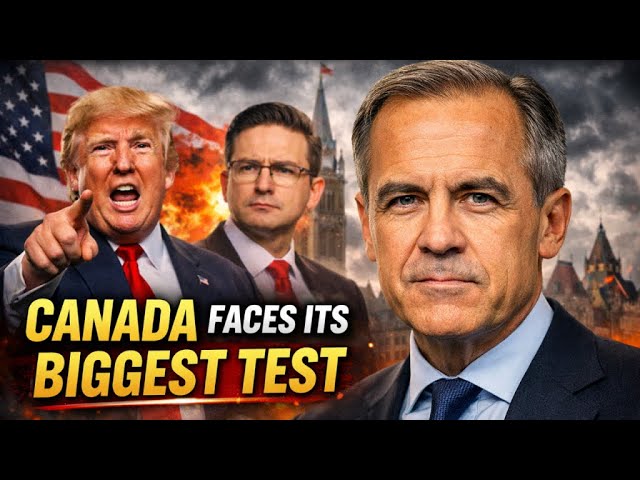
Canada is not easing into 2026. It is bracing for impact.
Economic uncertainty is mounting, global markets remain fragile, and geopolitical tensions are once again bleeding into domestic politics. Layered onto that pressure is an increasingly fractured political opposition, raising uncomfortable questions about who is actually prepared to govern in a crisis.
The Conservative Party, long positioned as a government-in-waiting, enters the year in visible distress. Under Pierre Poilievre’s leadership, internal divisions have intensified rather than settled. Leadership reviews, caucus unease, and quiet defections have replaced the image of unity the party once projected.
What was framed as a populist surge now looks increasingly fragile.

For voters, the concern is not ideological disagreement—it’s operational readiness. A party consumed by internal survival has limited capacity to manage external shocks. As economic and trade pressures rise, that weakness becomes harder to ignore.
The New Democratic Party is facing a different but equally destabilizing challenge. With Jagmeet Singh stepping aside, the NDP has entered a leadership contest at the worst possible moment. The party is debating its identity, its priorities, and its relevance while the country demands clarity.
Leadership transitions can energize political movements. They can also paralyze them. In a year defined by uncertainty, the NDP’s introspection risks pushing cautious voters toward what feels safest.
Against this backdrop, Mark Carney’s government appears unusually grounded.
Carney’s leadership style has never been theatrical. He does not dominate headlines or escalate conflict. Instead, he governs with what allies and critics alike describe as strategic discipline—absorbing pressure rather than amplifying it. That approach, shaped by decades of managing financial crises, is now being tested in a political arena increasingly hostile to nuance.
The economic challenges are immediate and tangible.

Rising tariffs from the United States threaten Canadian steel, aluminum, and automotive sectors—industries that anchor regional economies and employ hundreds of thousands. These are not symbolic disputes. They affect supply chains, investment decisions, and job security. Carney’s response has focused on mitigation and diversification rather than public confrontation, a strategy aimed at protecting long-term stability over short-term applause.
Domestically, affordability remains the defining issue for Canadian households. Housing costs remain high. Grocery prices continue to strain budgets. History shows that prolonged economic pressure can quickly morph into political volatility if leaders respond with slogans instead of solutions.
Carney’s government has chosen a different path—prioritizing structural reforms, infrastructure investment, and coordination with provinces. Progress has been incremental, sometimes frustratingly so. But it reflects a belief that resilience is built slowly, not announced dramatically.
National unity adds another layer of complexity.
Quebec’s political climate remains volatile, with identity and autonomy debates simmering beneath the surface. In Western Canada, frustrations over economic fairness and representation persist. Rather than inflaming those tensions, Carney has leaned into consultation—meeting provinces where they are, emphasizing negotiation over confrontation.
This approach has drawn criticism from those who equate strength with dominance. But in a federation under stress, stability often depends on patience more than force.
As 2026 unfolds, Canadians are being forced to reassess what leadership means in practice. The era of permanent campaigning collides with the reality of governing through uncertainty. Political movements built on outrage and internal mobilization may struggle when external pressures demand coordination, restraint, and credibility.
That contrast is becoming increasingly visible.

While opposition parties grapple with internal identity crises, Carney is already operating as if the worst-case scenarios are plausible—and preparing accordingly. That posture does not guarantee electoral success. But it does offer something rare in modern politics: predictability.
In times of global instability, predictability becomes political capital.
The year ahead will test Canada’s institutions, its economy, and its social fabric. Trade tensions, affordability pressures, and geopolitical uncertainty will not wait for parties to resolve their internal debates.
As voters look ahead, the question is no longer theoretical. It is practical: who can manage chaos without becoming part of it?
For now, Mark Carney appears to be the only leader acting as if governing—rather than campaigning—is the job at hand.
In 2026, that distinction may matter more than any slogan.