 A Woman Sealed for Millions of Years? The Mystery the Soviets Never Explained
In the remote heart of Siberia, far from major cities and modern laboratories, a story has circulated for decades that refuses to die.
It is whispered in forums, resurfaced in documentaries, and passed from one generation to the next with growing intensity.
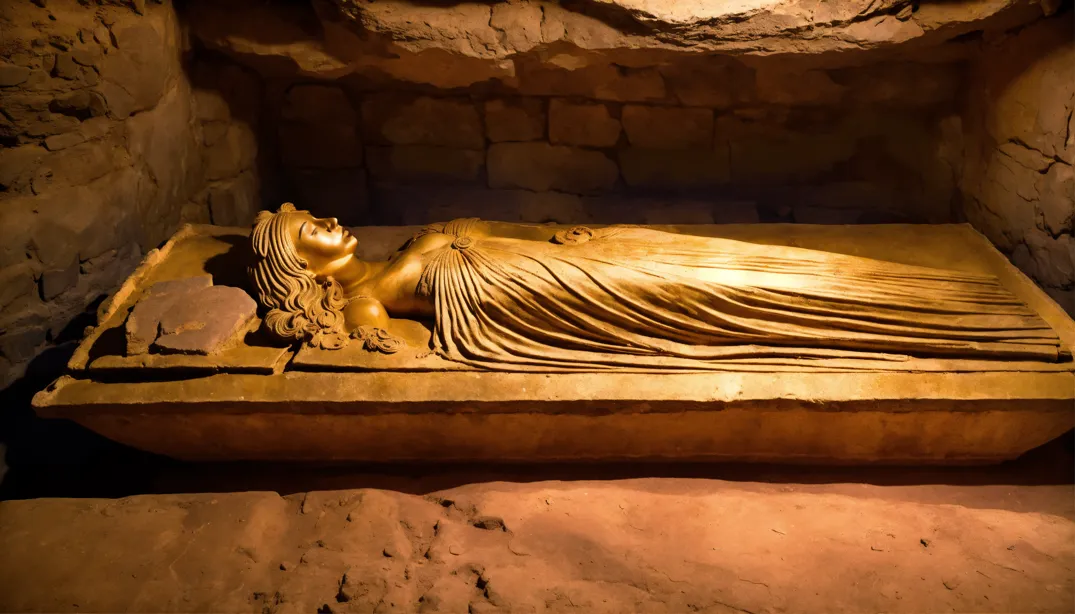
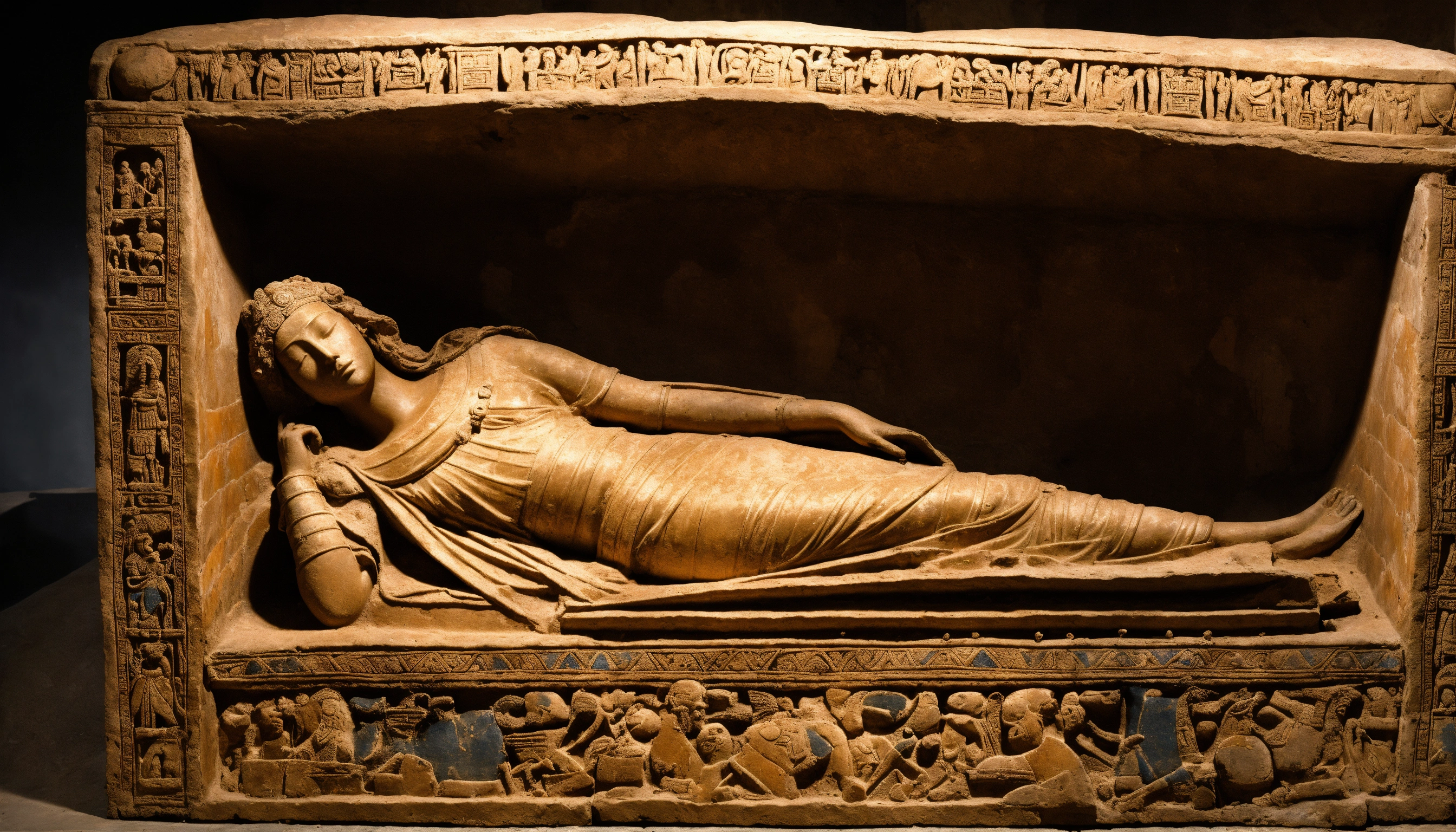
According to the legend, deep underground near a coal mine, Soviet scientists once uncovered a sealed coffin containing a perfectly preserved young woman — a figure now known as the Tisul Princess.
Her body, it is claimed, had remained untouched for hundreds of millions of years.
Her skin looked alive.
Her face appeared peaceful.
And when the coffin was opened, something went terribly wrong.
The story begins in 1969 near the small settlement of Tisul, during routine mining operations.

Workers allegedly struck a massive stone sarcophagus buried more than 70 meters below ground, embedded in coal layers dated to an impossibly ancient era.
When the lid was lifted, witnesses claimed they saw a young woman submerged in a strange blue-pink liquid, dressed in an unfamiliar fabric, her features flawless, as if asleep rather than dead.
Word spread quickly.
Within hours, military personnel and scientists reportedly arrived, sealing off the site.
Locals were ordered to remain silent.
According to the legend, several witnesses later died under mysterious circumstances.
Others vanished.
The coffin, the woman, and all documentation were said to have been transported to an unknown location.
No official Soviet records ever acknowledged the find.
This is where fascination turns into obsession.
The most disturbing element of the Tisul Princess story is not just her alleged appearance, but the timeline.
Coal seams at that depth are believed to be hundreds of millions of years old — long before humans, mammals, or even dinosaurs.
If the story were true, it would not merely rewrite human history.
It would destroy it.
Skeptics argue that the entire tale is a fabrication, born from Cold War secrecy, folklore, and mistranslation.
There are no peer-reviewed studies.
No photographs verified by independent experts.
No surviving samples.
And yet, the story persists, fed by the unsettling consistency of eyewitness accounts and the historical reality that the Soviet Union often concealed discoveries for political or ideological reasons.
Supporters of the legend point to strange details that repeat across testimonies.
The liquid preserving the body.
The immediate deterioration of the corpse once the coffin was exposed to air.
The rapid military response.
The alleged deaths of witnesses shortly afterward.
These elements, they argue, are too specific to be random invention.
Scientists, however, remain firm.
No known biological process could preserve a human body in such condition for even tens of thousands of years, let alone millions.
DNA breaks down.
Proteins decay.
Cells collapse.
Even the most exceptional preservation cases — ice mummies, bog bodies, desiccated remains — operate on timelines measured in thousands, not geological epochs.
And yet, modern discoveries continue to blur what was once thought impossible.
Preserved soft tissue in dinosaur fossils.

Ancient brains surviving thousands of years in oxygen-poor environments.
Microstructures enduring far longer than expected.
Each new finding gives just enough oxygen to stories like the Tisul Princess to keep them alive.
The comparison to Sleeping Beauty is unavoidable.
A woman frozen in time.
A sealed chamber.
A sudden awakening that ends in catastrophe.
But unlike fairy tales, this story has no happy ending — only silence, denial, and unanswered questions.
What makes the legend especially powerful is its setting.
Siberia is vast, remote, and still underexplored.
Entire regions remain geologically mapped but archaeologically untouched.
During the Soviet era, secrecy was policy, not exception.
Entire towns vanished from maps.
Scientific failures were buried alongside successes.
In that context, the idea that something extraordinary could be hidden indefinitely does not feel entirely impossible.
Still, historians caution against letting mystery replace evidence.
Many details of the story trace back to a single newspaper article published decades after the supposed discovery.
Names of scientists change.
Dates shift.
Locations blur.
These inconsistencies are hallmarks of folklore, not suppressed science.
Yet folklore often reflects deeper anxieties — fears that humanity’s past is not what we believe, that history is incomplete, that knowledge has been lost or deliberately erased.
The Tisul Princess taps into all of them.
If the story is false, why does it endure? Because it lives at the intersection of science, secrecy, and myth.
Because it challenges the comfort of established timelines.
Because it asks a question that unsettles even professionals: what if something truly impossible was found, and the world was never told?
No physical proof of the Tisul Princess has ever surfaced.
No museum holds her remains.
No archive lists her coffin.
Officially, she does not exist.
And yet, in the collective imagination, she sleeps on — sealed in stone, hidden beneath layers of earth and denial.
Whether hoax, legend, or misunderstood event, the Tisul Princess remains one of the most chilling mysteries of the modern age.
Not because she proves an alternative history — but because she exposes how fragile our certainty about the past really is.
And perhaps that is why the story refuses to fade.
Some mysteries do not need to be real to be powerful.