 Inside the Bunker The Evidence That Finally Ends Hitler’s Greatest Mystery
For more than eight decades, the final moments of Adolf Hitler have hovered between documented history and dark myth, feeding conspiracy theories, secret files, whispered rumors, and endless speculation.
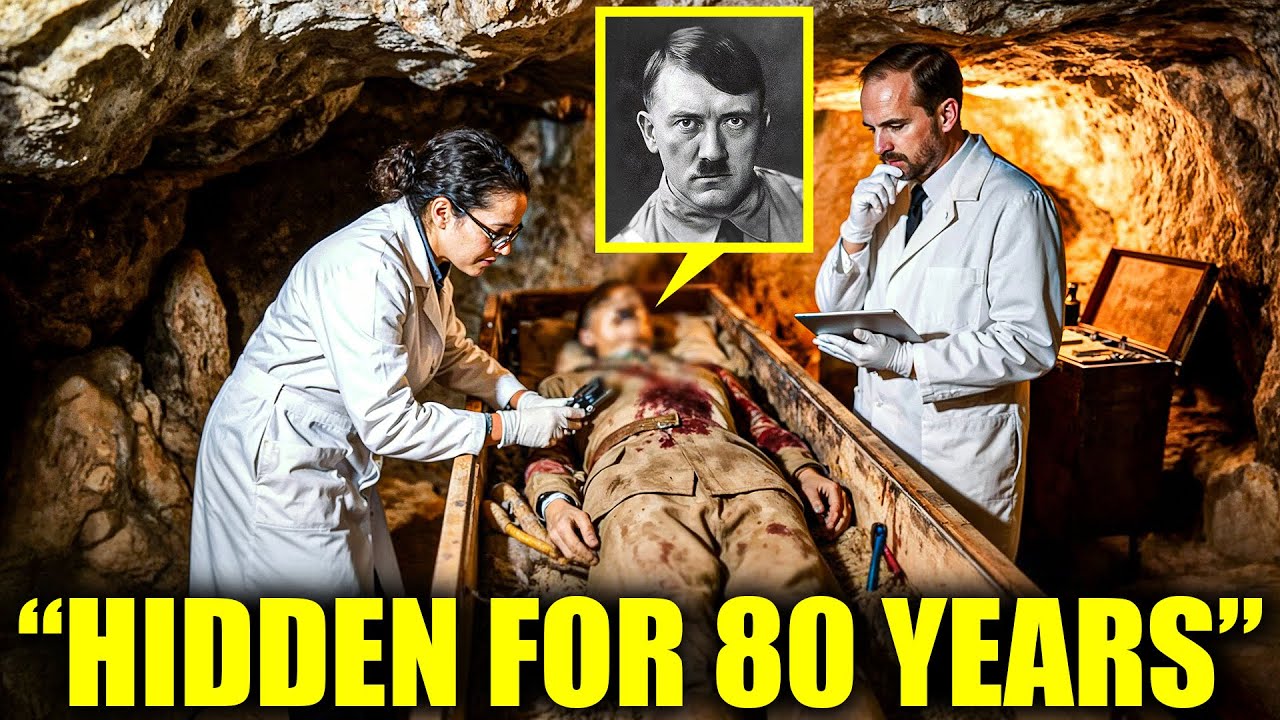
Did he truly die in Berlin, or did the architect of the most destructive regime in modern history slip through history’s fingers? The mystery has been retold so many times that certainty itself became suspect.
But when the full weight of evidence is placed side by side, when testimonies, forensic science, and declassified intelligence are examined without romance or fear, the conclusion that emerges is not thrilling, not cinematic, and certainly not comforting.
It is bleak, claustrophobic, and deeply unsettling.
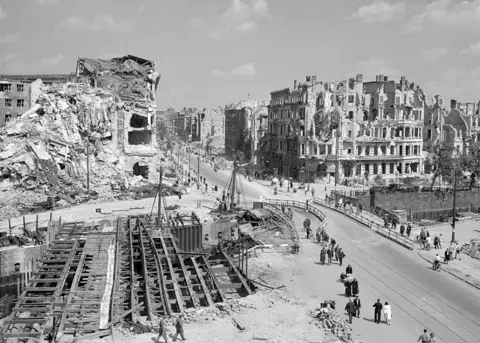
In April 1945, Berlin was no longer a capital but a graveyard.
Soviet artillery pounded the city day and night, reducing streets to rubble and filling the air with smoke, dust, and despair.
Deep beneath the ruins, in the reinforced concrete corridors of the Führerbunker, Hitler lived out his final days not as a commanding tyrant but as a broken man surrounded by decay, betrayal, and inevitable defeat.
The empire he promised would last a thousand years was collapsing in less than twelve.
His armies were shattered, his allies gone, and the population he claimed to defend was being annihilated street by street.
Witnesses inside the bunker later described a leader physically transformed.
His hands shook uncontrollably.
His posture was bent.
His once theatrical speeches were replaced by long silences, whispered rants, and delusions that imaginary divisions would save Berlin.
Yet even as reality closed in, he refused to flee.
Escape routes existed.
Aircraft were available.
Loyalists begged him to leave.
He declined every option.
Not out of courage, but out of obsession with control.
If the Reich was to die, it would die with him at its center.
On April 29, Hitler married Eva Braun in a brief, surreal ceremony beneath the collapsing city.
Hours later, he dictated his political and personal testament, blaming Jews, generals, and fate for a war he himself had unleashed.
There was no remorse, no acknowledgment of the millions murdered under his command.
Only bitterness and self-pity.
The next afternoon, April 30, 1945, the bunker doors closed one final time.
What happened next was deliberately hidden, not to protect Hitler, but to erase him.
According to multiple eyewitnesses who were present in the bunker, Hitler and Eva Braun entered his private room.
Moments later, a gunshot was heard.
When aides entered, they found Hitler slumped on a sofa, a pistol near his hand, blood on the carpet.
Eva Braun lay beside him, lifeless from cyanide poisoning.
Their bodies were carried upstairs into the Reich Chancellery garden, doused with petrol, and burned as Soviet shells fell nearby.
Hitler had ordered this himself, terrified of being paraded like Mussolini’s corpse.
This should have ended the story.
But it did not.
When Soviet forces captured the area, they recovered charred remains.
Stalin, suspicious by nature and eager to destabilize the West, deliberately spread uncertainty.
He hinted that Hitler might have escaped.

Soviet secrecy ensured that no immediate public proof was released.
Into that vacuum poured speculation.
Submarines to Argentina.
Safe houses in Antarctica.
Hidden Nazi colonies in South America.
Each theory fed a public hungry for drama and unable to accept that such evil could end so quietly.
For decades, fragments of physical evidence remained locked away in Soviet archives.
Among them were dental remains recovered from the bunker site.
This detail, seemingly minor, would later become decisive.
Hitler’s teeth were uniquely identifiable due to extensive dental work.
In the 1940s, dental records were precise, personal, and difficult to fake.
When Soviet authorities questioned Hitler’s dentist and dental assistants separately, their descriptions matched the remains exactly.
At the time, this information was classified, buried under Cold War secrecy.
In the 21st century, that secrecy finally cracked.
Russian authorities allowed international forensic experts to examine the preserved dental fragments and skull pieces attributed to Hitler.
Using modern forensic techniques, scientists compared the teeth with X-rays and records from Hitler’s dentist.
The result was unequivocal.
The match was exact.
There was no sign of forgery, substitution, or doubt.
The teeth belonged to Adolf Hitler.
Cyanide residue was detected, consistent with eyewitness accounts.
The skull fragment showed trauma compatible with a gunshot.
This is where the story becomes truly grim.
The mystery was not solved by a heroic escape or a dramatic last stand.
It was solved by decay, by paperwork, by teeth burned but still recognizable.
Hitler did not vanish into legend.
He did not outsmart history.

He died trapped underground, listening to the end of his world collapse above him.
The reason this conclusion feels unsatisfying to many is precisely because it denies narrative justice.
There was no trial.
No public reckoning.
No visible punishment proportionate to the crimes.
Instead, Hitler chose his own ending, escaping the courtroom but not the truth.
His death was not glorious.
It was small, cowardly, and frantic.
A man who commanded millions to die refused to face the consequences himself.
Yet the danger of the mystery was never really about Hitler’s fate.
It was about what uncertainty allows.
As long as doubt existed, extremists could mythologize him, recast him as a shadowy survivor, a symbol rather than a corpse.
Conspiracy kept him alive in imagination.
Evidence kills that fantasy.
Finality matters.
Today, historians overwhelmingly agree.
Intelligence agencies have closed the case.
Forensic science has sealed it.
Hitler died in Berlin in April 1945.
Not as a martyr.
Not as a mastermind escaping justice.
But as a defeated dictator hiding underground, surrounded by ruins, ending his own life as his ideology burned with him.
And that is why the truth is not good.
Because evil did not end with a bang.
It ended with a whisper, a shot in a bunker, and ashes scattered in a garden already soaked with blood.
History did not grant the world the satisfaction of seeing him answer for his crimes.
It only left us with responsibility.
To remember accurately.
To reject myth.
And to ensure that fascination never replaces truth.