 Could One Ancient Burial Change Everything We Thought We Knew About American History?
For more than a century, the story of how humans first arrived in the Americas has been one of archaeology’s most fiercely debated mysteries.
Competing theories rose and fell.
Timelines shifted.
Evidence was fragmented, often incomplete.
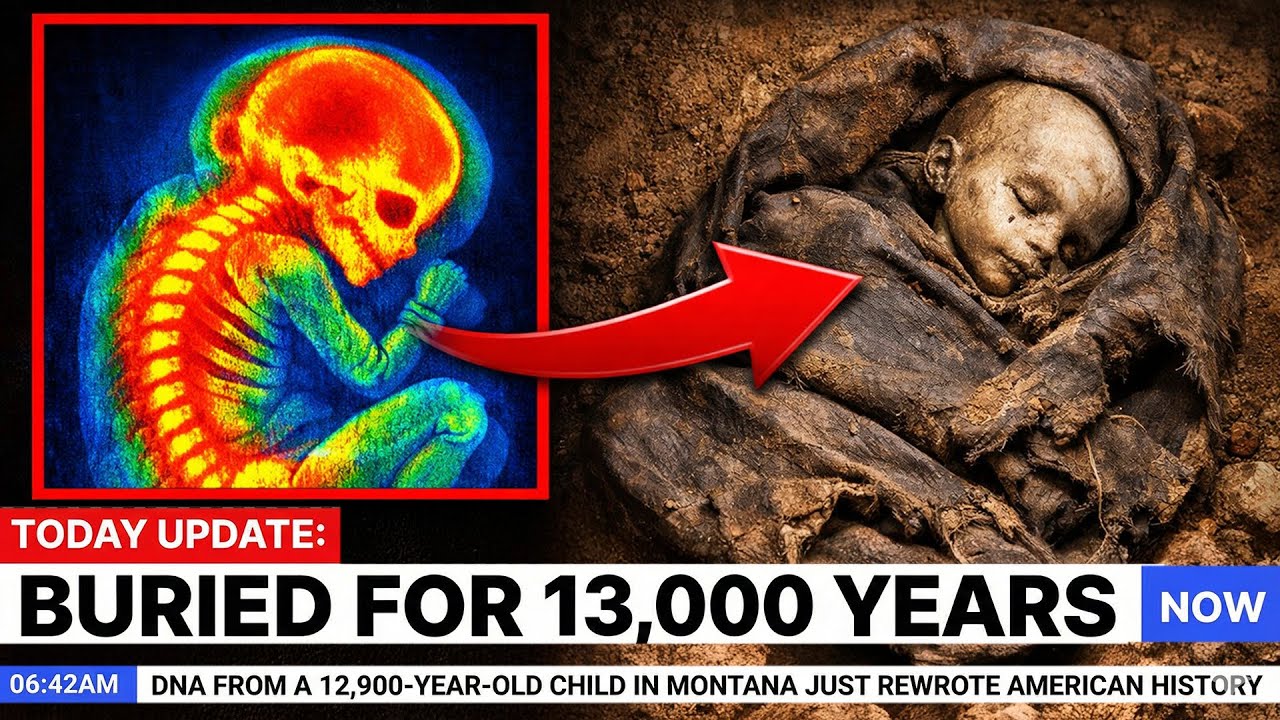
Then, hidden in plain sight for decades, the remains of a child who lived nearly 12,900 years ago quietly held an answer powerful enough to reshape that entire narrative.
When scientists finally unlocked the child’s DNA, it exposed a chapter of American history that had never been written before.
The child was buried during the last Ice Age, long before cities, borders, or recorded memory.
The grave was discovered in what is now Montana, accidentally uncovered during construction in the 1960s.
At the time, researchers recognized the importance of the stone tools placed with the remains, unmistakably linked to the ancient Clovis culture.
But technology had limits.
The bones were cataloged, studied, then largely set aside as debates about early Americans continued without them.
Decades later, advances in genetic science changed everything.
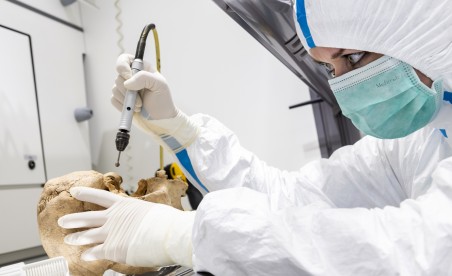
When a team of researchers carefully extracted and analyzed DNA from the child’s remains, what they found stunned the scientific world.
The genetic signature did not just confirm that the Clovis people were among the earliest inhabitants of North America.
It proved a direct ancestral link between those ancient populations and modern Indigenous peoples across both North and South America.
This was not a hypothetical connection.
It was biological proof.
The child, now known in scientific literature as Anzick-1, lived at a pivotal moment in human migration.
Vast ice sheets still covered much of the continent.
Sea levels were lower.
Migration routes were closing.
Until this discovery, some theories suggested that Clovis culture represented a later, possibly separate wave of settlers.
The DNA shattered that idea.
It showed continuity, not replacement.
What made the finding so dramatic was not just its age, but its clarity.
Ancient DNA is notoriously fragile.
Contamination, decay, and time erase genetic signals.
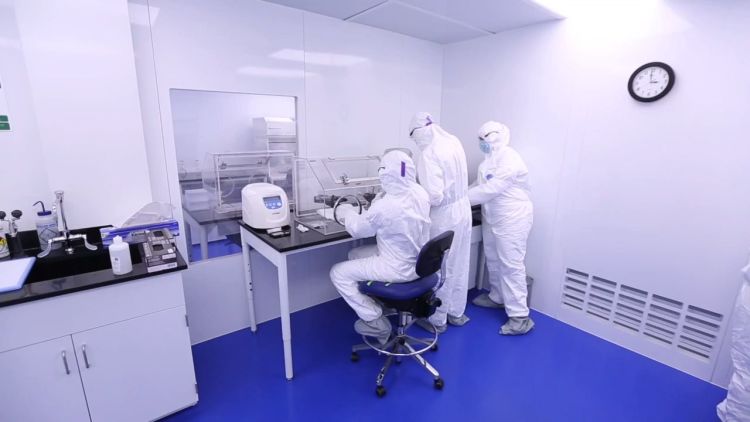
Yet this child’s genome was preserved well enough to reveal deep ancestry.
The data showed that nearly all Indigenous peoples of the Americas share a common origin rooted in this early population.
That meant the first Americans did not arrive in scattered, unrelated waves.
They came as part of a connected story.
The implications rippled far beyond archaeology.
For Indigenous communities, the discovery carried profound significance.
Oral histories had long spoken of deep roots in the land, predating written history by thousands of years.
The DNA evidence aligned with those traditions, validating them in the language of modern science.
It challenged narratives that framed Indigenous presence as recent or secondary.
The past, it turned out, was exactly as ancient as those communities had always said.
For scientists, the child’s DNA also closed doors.
Alternative theories suggesting that early Europeans or other distant populations were responsible for Clovis culture lost credibility overnight.
The genome showed no such connection.
Instead, it traced ancestry back to a population that crossed from Asia into the Americas via Beringia, then spread rapidly southward, adapting, surviving, and leaving descendants everywhere.
There was also an emotional weight to the discovery.
This was not an abstract data point.
It was a child, buried with care, surrounded by tools crafted by skilled hands.
The placement of artifacts suggested ritual, respect, and community.
The DNA analysis turned that silent burial into a voice, speaking across nearly 13,000 years.
Ethical questions followed.
Who owns ancient DNA? Who has the right to study it? Researchers worked closely with tribal representatives, acknowledging that this was not just a scientific specimen but an ancestor.
The collaboration marked a shift in how archaeology and genetics engage with Indigenous communities, emphasizing respect over extraction.
The story also highlighted how history can hide in storage rooms and museum drawers.
The remains had been known for decades, yet their true significance only emerged when technology caught up.
It was a reminder that the past is not fixed.
It waits.
As results were published and reviewed, textbooks began to change.
The timeline of the Americas sharpened.
The narrative simplified.
Instead of mystery layered on mystery, there was now a foundation.
One child’s DNA had done what decades of argument could not.
What makes this chapter so compelling is its quiet power.
There was no lost city, no golden artifact, no dramatic ruin emerging from the earth.
Just fragile bones and a genetic code that refused to stay silent.
In revealing who the first Americans were, the child also revealed who their descendants are today.
History often feels distant, impersonal.
This discovery made it intimate.
It connected the Ice Age to the present, science to tradition, and data to identity.
A single genome rewrote a continent’s origin story, not with speculation, but with certainty.
And perhaps the most unsettling realization of all is this: if one forgotten child could change everything we thought we knew, how many other hidden chapters are still waiting beneath the soil, patient, intact, and unheard?