Jason Landry’s disappearance confounded the state’s top investigators. When thousands of online sleuths got involved, intrigue turned into obsession.
 I. “The deeper you go, the stranger it gets.”
The day before he would take off his clothes and vanish into the rural countryside on a frigid night—defying logic, devastating those who loved him, and baffling some of the best criminal investigators in Texas—Jason Landry was thinking about socks. Not just any socks, but a colorful pair that featured an image of a monkey in a suit and tie holding a briefcase in one hand and a banana in the other, with the words “monkey business” stitched across each ankle. Socks were the highlight of an extensive, bullet-pointed Christmas list that Jason texted to his mother, Lisa, on Saturday, December 12, 2020. He preferred “wacky and cool socks,” he noted, not basic ones with “tacos or dogs on them.”
Jason, a lovable 21-year-old goofball who always seemed to be smiling, was normally the opposite of a list maker. Unlike his older siblings, both of whom were regimented and rule oriented, Jason eschewed rules and hated planning. At just over six feet tall, with olive skin and light brown hair, he had started college at Sam Houston State as a clean-cut kid from the Houston suburbs. After leaving home, he embraced his inner slacker, growing out his hair and trading his button-downs for tie-dyed hoodies and T-shirts. At first, he didn’t show much interest in classwork. Had he been born a few decades earlier, he might’ve drawn comparisons to Spicoli, the iconic stoner played by Sean Penn in Fast Times at Ridgemont High. But by his third year, he’d transferred to Texas State University, his grades had started to improve, and he was displaying more focus, leaving loved ones with the sense that he’d finally found his way.
What they couldn’t anticipate, of course, was the impact a semester of remote classes and isolation would have on him. The lack of human interaction during the COVID-19 pandemic was toxic for Jason, someone described by his dad as a “pure extrovert full of pure optimism,” someone who had been making friends with strangers since he was a toddler. To cope, Jason retreated into a cloud of pot smoke. “Given his personality, isolating him was one of the worst things you could do to him,” his father, Kent, a trial lawyer turned Presbyterian minister, told me when I visited the family’s home, in Missouri City. “He was stuck in a small apartment, in a small room on an empty floor. It was like solitary confinement for him, and I’m not surprised that he self-medicated.”
In the days before he disappeared, Jason appears to have done lots of self-medicating. Between ordering food from Chick-fil-A and Subway, he took close-up videos of marijuana buds and filmed himself talking earnestly about getting his life “on the right track.” In Instagram messages that were later released by law enforcement, Jason told a close friend that with the help of drugs, he’d found God and truly seen him for the “first time ever.” It may or may not have been a playful exchange, but according to friends and the clues preserved in Jason’s internet history, he may have avoided food and sleep that week to intensify the potency of the pot he was smoking. Jack Frank, who had known Jason since the seventh grade, had started to worry about his longtime friend. “It seemed more and more apparent that our conversations weren’t making sense anymore,” he said. “Jason would talk about the rapture coming, aliens, Jesus, Elon Musk, and all these things that he would tie together somehow.”
Jason had developed an interest in mysticism and referenced films like DMT: The Spirit Molecule, a popular documentary featuring a clinical psychiatrist who is exploring connections between psychedelics and near-death and spiritual experiences. “Dude, I lowkey have always wanted to be a monk and reach spiritual enlightenment some day and levitate from meditation or turn into a stone statue and achieve Nirvana or something,” Jason messaged a friend on Instagram that weekend.
And yet, despite Jason apparently pushing his body to extremes, family members who spoke with him that weekend said that for the most part, he appeared to be himself. “On Saturday, he sounded just like Jason to me,” Lisa recalled. “He was very excited about the next semester, and I remember rolling my eyes because he was talking, talking, talking, but he still hadn’t gotten to his point.”
At his apartment in San Marcos the following evening, Jason spent 45 minutes talking to a friend on FaceTime. No sound was recorded, but in the video, he appears to be alert and outgoing as he rolls joints and chats, though some have pointed out that he has sweat marks under his armpits—a potential sign of anxiety that others have speculated had more to do with him having possibly just done pull-ups in his bedroom.
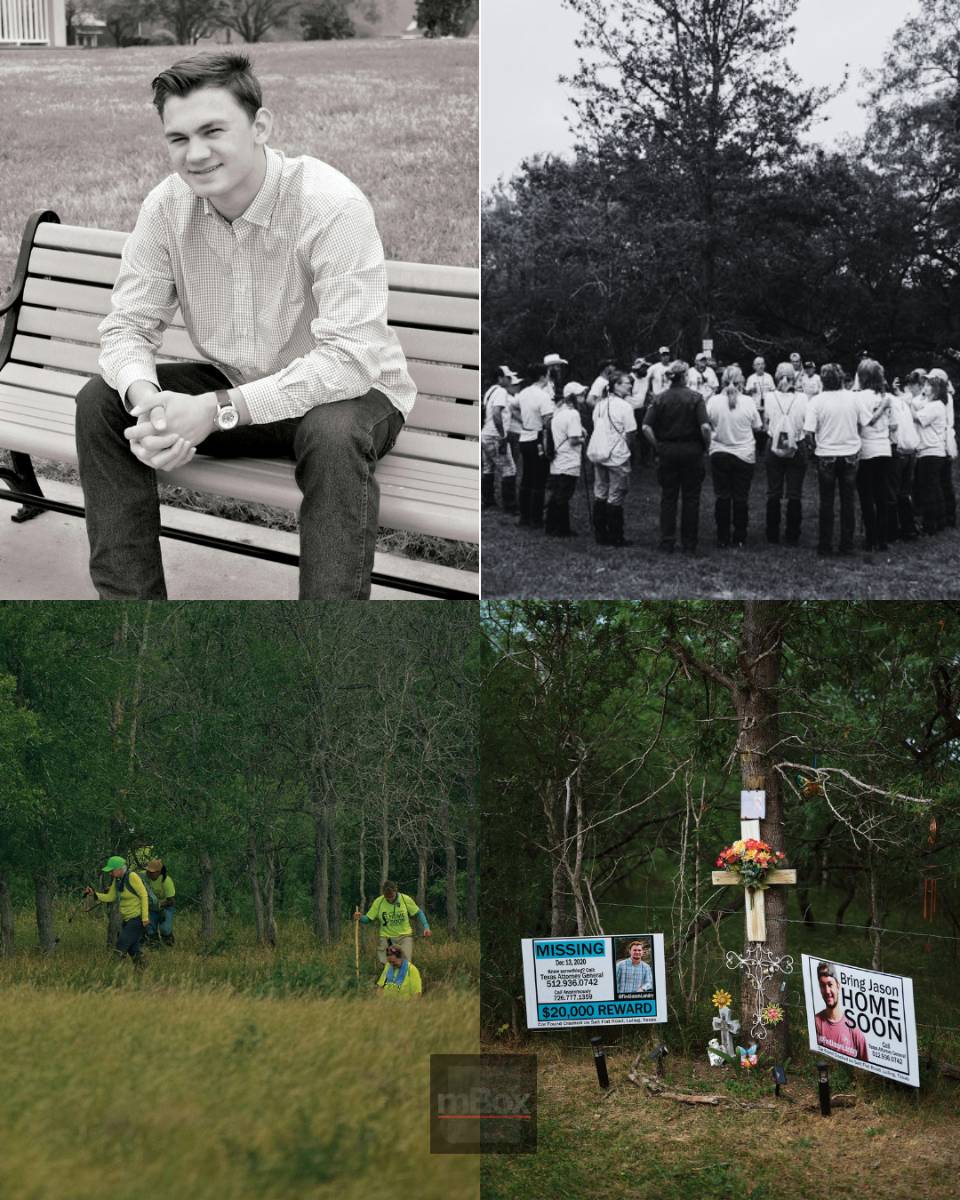
 Jason’s high school senior portrait, taken in March 2018.Courtesy of the Landry family
At some point that night, Jason decided to drive home. He packed a bag of toiletries, a PlayStation game console, a laptop, and a handful of joints hidden inside a pill container he’d stuffed into a black backpack. He placed his Siamese fighting fish, Sparky, into a plastic tumbler that he used as a pet carrier. Though a cold front had swept through Central Texas hours earlier, kicking up winds that would eventually plunge temperatures into the mid-thirties, Jason was dressed for more temperate weather. He was wearing a T-shirt, shorts, sandals, and a pair of SpongeBob-themed socks when he loaded his belongings into his tan 2003 Nissan Altima and programmed his Waze app to guide him to Missouri City, a 165-mile trip that should’ve taken a little over two and a half hours.
By 11 p.m., Jason was on the road, and within about ten minutes, he’d crossed into Caldwell County via Texas Highway 80, a busy thoroughfare linking San Marcos to Luling, a small oil-and-ranching community 25 miles to the southeast. Jason spent portions of the drive communicating with a friend and his ex-girlfriend on FaceTime and Snapchat. He’d finished his finals days earlier and had wrapped up his last shift at Jimmy John’s that same week. He was, by all accounts, in good spirits and in decent physical shape, with much to look forward to, including a month off from school. He may have noticed that the sky was clear and moonless, lit up by a Geminid meteor shower, which would’ve appeared even more dazzling in the Texas countryside—a mystical moment come to life right before his eyes.
There’s no telling whether he did look up, or why, exactly, when he reached Luling, at 11:24 p.m., he abruptly stopped using Waze. Instead of turning right on Magnolia Avenue, which would’ve taken him toward Interstate 10 and, eventually, the Houston suburbs, Jason’s car apparently continued straight for several blocks. The street eventually bends to the left and turns into Salt Flat Road, leading farther away from Jason’s destination. His Altima continued down that road for five miles. At 11:28 p.m., Jason sent his ex-girlfriend a final Snapchat selfie from inside the vehicle. He looked calm and confident, a young man convinced, as he so often was, that everything would work out in the end.
It would be the last time any of his friends or loved ones ever saw or heard from him.
By the time I heard the name Jason Landry, the college student had been missing for nearly three years. I was sitting in a neat, windowless room on the ground floor of the School of Criminal Justice and Criminology building at Texas State, a map of Jack the Ripper’s nineteenth-century murder spree hanging on the wall. This was the office of renowned criminologist Kim Rossmo. He’d invited me to meet with his undergraduate students in a class on serial murder to discuss an article I’d written debunking the notion that a killer was targeting young men in a popular nightlife district in downtown Austin. I’d argued that the “Rainey Street Ripper,” as the alleged murderer had become known on social media, was little more than a fiction created by 𝓿𝒾𝓇𝒶𝓁 hysteria that was then amplified by self-styled investigators. The story had unleashed a barrage of vitriol. On a Facebook forum dedicated to proving the killer’s existence, I was accused of hiding facts and participating in a police cover-up.
Read Next:
Reality Check: There’s Almost Certainly No Serial Killer in Austin
Rossmo was less interested in the particulars of the alleged murders than in the way misinformation had spread across social media, fueling a digital mob that had the potential to interfere with “active criminal investigations,” as he explained over email. (Flooded with online hatred, Austin’s police chief was compelled to address the serial killer rumors.) That same year, Rossmo had given a presentation on the topic at a law enforcement conference.
Though he currently serves as the director of the Center for Geospatial Intelligence and Investigation at Texas State, there was a time, decades ago, when Rossmo was a no-nonsense beat cop who patrolled a high-crime neighborhood in Vancouver, Canada. Today it’s hard to imagine the balding seventy-year-old academic as anything other than a polite professor.
 Renowned criminologist Kim Rossmo in his home office, in Austin.Photograph by Nick Simonite
But Rossmo is considered by many experts to be a modern-day Sherlock Holmes, a rare criminal investigator who fuses real-world experience with a sophisticated academic understanding of crime. These days, his burning intensity reveals itself only in flashes, occasionally overriding his courteous Canadian exterior when he shows his contempt for serial predators or extols the virtues of obsessively dedicating yourself to tracking them down.
Sitting in his office after my presentation, Rossmo said the case of the alleged Austin serial killer wasn’t the first time he’d observed the impact social media can have on an investigation. A couple of years earlier, after discussing Jason Landry’s case during an academic lecture, the professor had been shocked by the criticism he received online.
Rossmo had observed a similar intensity among social media sleuths on high-profile cases he’d investigated over the years—the Austin yogurt shop murders, the Zodiac Killer, Jack the Ripper. But he was surprised to see the same “territoriality” cropping up in a relatively low-profile missing persons case in small-town Texas. “Not everyone thinks they can be a military general or a neurosurgeon, but everyone thinks they’re a detective,” Rossmo told me.
Though I didn’t know it at the time, I would soon learn that there was something about Jason’s case that transcended the lurid intrigue that tends to drive interest in 𝓿𝒾𝓇𝒶𝓁 crimes. It wasn’t just the unusually perplexing conditions surrounding his disappearance, the bizarre twists of the ensuing investigation, or Jason’s playful and endearing personality. Like a haunted house that gradually causes its occupants to lose their grip on reality, there was something about Jason’s story that tended to warp its adherents over time, turning ordinary curiosity into obsession and everyday reality into a fantastical world of mystery, discovery, and 𝒹𝓇𝒶𝓂𝒶.
Online, the Jason Landry universe is sprawling and active, attracting accomplished investigators and amateur sleuths alike. About a dozen Facebook pages totaling around 50,000 members dissect the case regularly, often drawing from a small library of local news clippings and true crime podcasts that have highlighted the disappearance. For many, Jason’s story is little more than a real-life game of Clue.
But there are well-meaning folks too, many of them middle-aged parents who are drawn to Jason’s case for reasons they cannot easily explain. They have been consumed by the seemingly impenetrable mystery surrounding the disappearance of a young man they never met but have come to love as if he were one of their own.
Not so long ago, if you’d told Cyndi Lay, an administrator of one of the Jason Landry Facebook groups, that she’d someday spend her weekends scouring pastures for human remains, she’d have thought you were unhinged. For Lay, though, Jason Landry isn’t just a case—he’s a calling. “When you’re looking for something that is missing, you have to believe,” she said. “You have to almost manifest it with faith. But my beliefs aren’t normal—they’re borderline crazy.”
Among members of the Facebook groups, Lay’s commitment to the case isn’t all that unusual. Jim West, a 55-year-old Houston-area software executive and the coleader of a volunteer Jason Landry search team, estimates he’s spent around $50,000 of his own money trying to decode Jason’s disappearance. “It’s as if a UFO came down, sucked him up into a beam of light, and flew away,” West said. “The deeper you go, the stranger it gets.”
 Jason (center), age three, with sister Jessica and brother Kyle, on a family beach vacation in 2002.Photograph by Nick Simonite
II. “What should we do besides pray?”
It wasn’t uncommon for people to ditch their vehicles along Salt Flat Road. The seven-mile passage begins as a paved surface in downtown Luling before turning to gravel as it meanders through the Central Texas countryside, tracing the edges of oil fields that reek of rotten eggs and sprawling ranches where you can wander for hours without seeing another soul. Once the sun goes down, locals say, the unlit road is the preferred thoroughfare of drunks, joyriders, and meth heads, as well as anyone else eager to evade the attention of law enforcement.
Late in the night, when the only sounds are the haunting whines of rusty pump jacks rising and falling in nearby fields, an abandoned vehicle occasionally appears alongside the road like a shipwreck upon a treacherous coastline. Sometimes it belongs to a rancher with a flat tire, other times to an oil worker who took a sharp corner too fast and slammed into a barbed wire fence.
At first glance, Jason’s Altima seemed no different from any other abandoned vehicle when it was spotted beside Salt Flat Road at around 12:30 a.m., about an hour after Jason stopped responding to messages on his phone. Though the vehicle was wedged against a tree and facing the wrong direction, the sedan’s airbag hadn’t deployed. There was significant damage to the body, and the rear window was shattered. The engine was off, but the keys were still in the ignition, and the vehicle’s headlights were shining.
A local volunteer firefighter was the first to report the wrecked Nissan. At around 1:15 a.m., police arrived. They theorized that the Altima’s driver had exited the vehicle through the back window before fleeing the scene. (Investigators would later conclude that the driver likely exited by squeezing through the driver’s side door, which was inches from a barbed wire fence.) “Probably some college kid,” Texas state trooper Cristobal Flores told a Caldwell County sheriff’s deputy as they surveyed the scene, in a conversation that was recorded on the officers’ body cam footage. “What in the world was he doing down this road?”
The wreck might have seemed unremarkable to the trooper had it not been for something else that the volunteer firefighter called to his attention. About nine hundred feet away from the Altima, Jason’s black backpack was sitting on the side of Salt Flat Road. Inside, Flores found Jason’s wallet and laptop, as well as his marijuana stash. His Ziploc bag was full of toiletries, and the plastic tumbler holding his fish had been placed on the ground nearby. Sparky was already dead.
Jason’s clothing was lying in the middle of the road a few dozen feet away, but it hadn’t been haphazardly discarded so much as dropped neatly into small piles, as if someone had casually stripped down before stepping into a shower. There was a faded red T-shirt from Camp Cho-Yeh, the Christian summer camp where Jason had worked. One of its armholes was still facing upward, and beneath it, a wristwatch had been placed face up, almost like it had been laid upon a dresser before bedtime. There was a pair of black Nike shorts, followed by gray underwear with a small bloodstain on the waistband. A pair of black slide sandals and two socks rested nearby. Fleeing the scene of a wreck was one thing, but doing so naked and barefoot on a wintry night was quite another. If Jason was still out there, he was almost certainly in trouble.
By the time the trooper reached Lisa and Kent Landry—both of whom were asleep at their home—the gravity of the situation seemed to be setting in. Flores told the couple that he’d found “narcotics” in Jason’s backpack and that their son was nowhere to be found. “He may be under the influence, and because of that, maybe that’s why he took his clothes off, if those are his clothes in the dirt road,” Flores told them. “With the way the temperatures are out here in the dark country, clear night, it feels like it’s thirty-some-odd degrees, especially with the way the winds have been blowin’.”
Struggling to make sense of the situation, Kent wondered aloud if he should drive out there. “What should we do besides pray?”
Soon Kent was racing to Luling in his Honda CR-V, taking sips of coffee as he tried to steady his nerves. He felt certain he’d find his son once he arrived, bringing the nightmarish episode to a swift conclusion. He’d packed a blanket and an extra pair of warm clothes for Jason. But when he pulled up to the crash site, the bad dream only seemed to intensify. It was nearly seven in the morning, and Jason was nowhere to be found. Neither was his vehicle, which police had already towed to a local impound yard. To Kent’s shock, there was no crime scene 𝓉𝒶𝓅𝑒, no detectives were on hand, and nobody was searching the area for his son in the cold.
Lisa said that when she called Flores, the trooper had gone home and was in bed. (The Texas Department of Public Safety declined an interview request on Flores’s behalf, and the Caldwell County Sheriff’s Office declined to answer questions.) Unsure of what to do as he wandered the vicinity on foot, the increasingly frantic father began filming the crash site, attempting to document the tire marks in the gravel roadway and the layout of his son’s clothes, which were still lying on the road as the early-morning sun began to illuminate the landscape. If Kent had had any doubt that he was looking at his son’s belongings, he knew for certain as soon as he saw the color of the socks: “They were yellow–and–light blue SpongeBob socks, the kind that Jason loved.”
Later that morning, when he got access to Jason’s car, he found his son’s cellphone—a critical piece of evidence—still lodged between the driver’s seat and the center console. The reality of his son’s predicament began to crystallize. In the first few hours after Jason’s disappearance—generally the most crucial period in any missing persons case—Kent felt like he was almost entirely on his own.
Lisa said Flores told her that when someone leaves the scene of an accident, police assume they have something to hide. Kent said law enforcement seemed to stop caring about his son’s whereabouts the moment they discovered marijuana in his backpack. “Regardless of whether Jason was drunk, stoned, or any of the above,” Kent said, “you had what you thought was a naked college student wandering a place he did not know in freezing-cold weather with arctic winds. You need to find that person and save them from themselves. However they got in that situation, find them and help them.”
Though it would take most of the day for the search-and-rescue machine to fully sputter awake, there were early attempts to locate Jason. That morning, the San Marcos Police Department reached his roommate by phone and confirmed that he had not heard from Jason. During a welfare check at the apartment, police found no sign of the missing student. The same day, the Texas Department of Public Safety, which initially led the investigation, contacted Texas Search and Rescue, a nonprofit first responder group that works closely with law enforcement, which quickly launched its own search effort. Texas EquuSearch, another nonprofit search-and-recovery team, later arrived at the scene.
By evening, the search crews had brought in dogs trained in human-scent detection. Over the next few days, more than a hundred volunteers clad in bright orange shirts scoured the area on foot, on horses, and in all-terrain vehicles. Oil-storage tanks were inspected, abandoned shacks were searched, and Jason’s face was circulated by news outlets across the state. Technicians sent drones into the sky, and volunteers wearing wet suits walked into murky, ice-cold creeks. A helicopter and a small plane were deployed, covering a vast search zone that would eventually total more than 31,000 acres.
Kent, who refused to return home, tried to help as best he could, all while trying to process an unthinkable ordeal that seemed to worsen with each passing hour. He was joined by Jason’s older brother, Kyle. The Caldwell County judge allowed them to stay in his personal RV a short distance from the crash site. Lisa checked into a nearby hotel, along with Jason’s sister, Jessica, and her husband. Some twenty family members arrived at various points.
 A search party scouring the countryside near Luling on May 17, looking for evidence of Jason Landry’s disappearance.Photograph by Nick Simonite
As the search wore on, Kent seemed to stop crying only when he was praying for his son or talking to reporters about the importance of having faith in Jesus. His son’s disappearance, he’d decided, had meaning, though it had yet to fully reveal itself. At the very least, it offered him a chance to evangelize, even if it meant exposing the depths of his own pain. “We’ve all made mistakes,” he tearfully told a Houston-based television station, looking directly into the camera. “We’re all sinners in need of God’s grace and mercy. Forgive your kids, give them a hug, tell them you understand.”
By Wednesday, two days after Jason’s disappearance, much of the search effort was focused on a small pond about a thousand yards from the crash site. Eight different dogs had signaled that there might be human remains in the water. After a boat equipped with a sonar device detected something not far offshore, a dive team from San Marcos entered the pond, but it found no sign of Jason after hours of searching. Later, a drone would spot objects that turned out to be turtles. After securing permission from the landowner and pumping equipment from nearby oil operators, searchers drained the entire pond, a days-long process.
It seemed overwhelmingly likely that Jason had entered the murky green water and drowned the night he disappeared. It was just a matter of time, rescuers thought, before the pond would yield the young man’s body. Their confidence came in large part from the dogs. After smelling Jason’s T-shirt, one had “pulled hard” to the pond, showing “no deviation whatsoever on a hot, hot trail,” according to Shawn Hohnstreiter, who at the time oversaw field operations for Texas Search and Rescue.
Hohnstreiter, one of the first rescuers on the scene that week, had the unenviable task of keeping the Landry family informed about developments. “When we decided to drain the pond, I told Kent, ‘You know, I hope that I’m wrong,’ ” he said. “ ‘You know what our information is telling us. We hope Jason’s not there, and if we are wrong, I realize I’m taking you through living hell.’ ”
From the crash site, Kent could hear the pumps rumbling in the distance day and night. He was tormented by an image of his son’s lifeless body floating in the muddy water. He expected with each passing minute that Hohnstreiter would approach with news that searchers had located Jason’s corpse, a prolonged limbo he would later describe as “torture.” As the water level gradually receded, he took to standing atop a small hill overlooking the pond, anxiously awaiting some indication that his limbo might come to an end.
After three days of pumping, the pond had been reduced to a giant, muddy pit—one without a body. Hohnstreiter sloshed through what little water remained, digging his bare hands into the mud. The reality that Jason’s body wasn’t at the bottom of the pond was almost incomprehensible. “We have bodies in Lake Travis that are one hundred and forty feet down, and the dogs can still alert on them,” he said. “And here you’re at a pond that’s eight feet deep and they’re alerting on someone who isn’t there, and you’re just baffled.”
For Kent, the confusion contained a sliver of relief. “It meant there was still hope that Jason was alive.”

Kent and Lisa Landry at their home, in Missouri City.Photograph by Nick Simonite

A few of Jason’s belongings.Photograph by Nick Simonite
III. “There’s more to this story.”
The dogs continued to signal intense interest in various bodies of water in the area, several more of which were drained but revealed no traces of Jason. Over time, searchers began to suspect that they were encountering a chemical phenomenon beyond the known borders of olfactory science, something capable of interfering with their dogs’ extraordinary ability to accurately process scent information. “We’ve talked to a scientist that has suggested something in the oil-production process when mixed with water is creating the illusion of human decomposition,” Hohnstreiter said. “We don’t know if it’s true. We need scientific research and white papers to understand what happened out there.”
The mystery surrounding the stock pond gnaws at him and other searchers, many of whom still struggle to accept that Jason wasn’t found. Their bewilderment is illustrative of the entire case: Even Jason’s scent seemed to vanish in a way that defied explanation.
After nine days on the ground, Texas Search and Rescue suspended its initial search, though the group would drop in for another three-day search in February, as well as for several more in the coming years. The Landrys were left to ponder a number of baffling questions: If Jason never entered the pond, he must have walked somewhere else in the vicinity. How did he evade so many searchers on foot? Why wasn’t his body detected by drones and helicopters flying across the county, some with infrared technology capable of capturing a heat signature even after death?
The Caldwell County Sheriff’s Office would eventually admit that when officers left the crash site the night of Jason’s disappearance, a critical period for searching was lost. Kent couldn’t help but wonder if things might have turned out differently had the response been more urgent. “It’s weird when you compare Jason’s case to Gabby Petito,” he said, referring to the 22-year-old woman whose body was found in a national forest after she was apparently murdered by her fiancé during a cross-country van trip in 2021. “They literally searched entire states and found her in some of the most inhospitable terrain around, and we can’t find Jason in a cow pasture outside Luling, Texas.”
Several factors complicated Jason’s case. He may have been under the influence when he went missing, as many investigators suspect, or he may have been suffering from a head injury following the wreck—perhaps both. When a victim is mentally impaired, Hohnstreiter said, rescuers struggle to get inside their head and project their movements.
Hohnstreiter also wonders whether that night’s meteor shower played a larger role than he realized at the time. “Imagine if Jason hit his head or was in an altered state of mind, and when he steps out of his car, he looks up, and the sky is literally falling,” he said. One officer working that night said it “looked like the sky was raining.”
“What does someone do in that situation if they’ve been talking about aliens and various supernatural kinds of things?” Hohnstreiter wondered. “I don’t think we know.”
Jason didn’t wander into a typical cow pasture, either. After discarding his clothing, he appears to have walked into some of the most unforgiving country in Central Texas, a hilly, wooded landscape fragmented by barbed wire, carved open by steep gullies and murky creeks, and littered with aging electrical equipment and rusted oil pumps.
Oil was first discovered in Luling roughly a century ago, in 1922. By then, Luling had a well-earned reputation as the “toughest town in Texas.” Legend has it that notorious gunfighters like John Wesley Hardin and Ben Thompson often passed through. One of the last gunfights there took place in 1914, when a dispute between merchants led to a double homicide in front of a downtown mercantile building that now houses the Luling Oil Museum.
Though the gunfight era soon came to an end, violence surged once Luling became a boomtown. By day, roughnecks risked their lives doing some of the most dangerous work around. By night, many retired to “Rag Town,” a grimy, anything goes tent city that, according to local lore, was home to makeshift saloons, gambling, fights, a shooting gallery, and dysentery. “You had all these cowboys that were still hanging around town, and they turned into roughnecks. They were rowdy, absolutely rowdy thugs,” said Tracy Perryman, the president of the museum, whose family has been in the oil business since the boom’s earliest days. “This was a rough and tough town, and even now, a century later, it’s still a pretty tough place.”
Six months before Jason went missing, two teenage boys were gunned down on a rural road several miles from where Jason’s car was found. Klayton Manning, an 18-year-old volunteer firefighter for Southeast Caldwell County Volunteer Fire Department, and his 16-year-old cousin, Landin Robinson, were reportedly checking for smoke in the area when they were hit by a hail of more than fifty bullets. The killer, 34-year-old Bryan Haynes, would, according to his arrest affidavit, later tell family members he was being chased by “aliens.” Haynes explained that he was forced to shoot the pair in “the middle and head area to make sure they would die.”
For decades, methamphetamine has been a scourge in many of the small towns scattered across Central Texas. In 2022 the Caldwell County Sheriff’s Office announced that it had seized around three hundred pounds of meth, the largest bust in county history. “Highly addictive drugs like methamphetamine are dangerous and killing our people at an alarmingly high rate,” Sheriff Mike Lane said at the time.
Despite periodic violence, Luling has for the most part sanded down its rugged edges, refashioning itself as a charming small-town destination. Increasingly, it’s a commuter community that attracts professionals who work in Austin and San Antonio, and the historic downtown is home to coffee shops, gift shops, world-famous barbecue, and Luling’s annual Watermelon Thump, a four-day festival celebrating local agriculture.
The local economy is dominated by farms and ranches, though lots of those operations have oil wells on their land that still produce several barrels a week. For Perryman, the abundance of wells is what makes Jason’s disappearance so puzzling. Jason’s car was found in what is essentially the middle of a miles-long oil field covered with about a thousand wells spread across numerous properties. Across the road from the wreck, Perryman’s family has a lease with two wells, which require daily checks from a small fleet of workers who service his property and others.
The fact that no sign of Jason has ever been found is “bizarre,” Perryman said. “It’s not like it’s the middle of nowhere, with no people and just some cows and nobody ever goes out there. There’s people out there every day—every single day. So, yeah, it’s very, very strange. And that’s why I think there’s more to this story than Jason just driving off the road.”
 An aerial view of the pond that was drained early on in the search efforts.Photograph by Nick Simonite
IV. “A possible suspect.”
By February 2021, two months after Jason went missing, outsiders, propelled by local television coverage, were already being drawn into the case. Details of the mystery were being shared widely and debated on social media.
On true crime Facebook pages, users wondered whether someone else was behind the wheel of Jason’s vehicle when it crashed. Some suggested he was being chased by a serial killer who’d supposedly been targeting motorists across Texas. The hosts of the chart-topping Crime Junkie podcast claimed that Jason’s case was part of a “strange phenomenon” of young men going missing from their cars. In the early stages of the investigation, while detectives were working to follow up on important leads, true crime fanatics flooded the sheriff’s office with bogus tips and public-information requests.
Into this fray stepped Rossmo, the famed criminologist. Though he is now immersed in the world of academia, he’s still a cop at heart, one who remains committed to tracking violent criminals. The dedication page on his latest book doesn’t mention a person but instead honors a calling: “To those who hunt the predators.”
During his studies, Rossmo had become interested in serial crimes, which can prove more difficult to solve in part because, unlike with one-off offenses, victims typically aren’t familiar with their attackers. He developed an algorithm for calculating the probable location of an offender’s residence and used it to create a technique known as geographic profiling. The statistical tool helps investigators prioritize suspects, tips, and locations worthy of further inspection. The technique has been used to find serial rapists, arsonists, and murderers around the world, but also for a wide variety of other purposes—determining the probable sources of IEDs in Afghanistan, tracking the hunting patterns of great white sharks, mapping the origins of infectious diseases, and helping the search to uncover the identity of Banksy, the secretive British street artist. Rossmo was even involved in an investigation that eventually led to the discovery of his home country’s most notorious serial killer, Robert Pickton, a farmer who is believed to have strangled dozens of Vancouver 𝒔𝒆𝒙 workers before feeding their remains to his pigs.
When he’s not teaching, Rossmo consults on cases all over the world. Back in San Marcos, his classroom is a pulpit from which he spreads the gospel of hyperrationalism. When it comes to criminal investigations, he argues, reason and logic, not emotion, should guide decisions and beliefs.
When the Caldwell County Sheriff’s Office asked Rossmo to assist in the search effort, he created a geographic profile of the area where Jason went missing. He visited Salt Flat Road in the daytime and again at night, during the hour in which Jason had disappeared. One of the first things he did was try to re-create Jason’s steps by taking off his shoes and walking down the gravel road barefoot at midnight. “I made it ten steps before I said, ‘F— this!’ ” Rossmo said. “It was too painful.”
About a mile from the crash site that same night, Rossmo, on foot and holding a flashlight, said he approached a group of people who appeared to be oil workers, though he couldn’t make out who he was talking to. After telling them he was working on the Jason Landry case, Rossmo said he asked whether some of the nearby structures would’ve had lights on in December. “No,” Rossmo recalled a woman’s voice replying. “You need to leave now. You’re on private property.”
“Okay,” he shot back. “But I’m not on your property.”
He got into his car and drove to a bridge that crossed a nearby creek. Several minutes later, as he stood near the bridge, a pair of fast-moving headlights appeared in the distance. As they grew closer, Rossmo could tell they belonged to a truck, which came to a stop right next to him.
When he approached the truck, he said, the driver had a shotgun pointed at his chest. More furious than scared, Rossmo noticed that the man had a license plate identifying himself as a veteran. “I’m saying things to him that are probably not very smart, like ‘What branch of the military are you embarrassing today?’ ” Rossmo recalled. “He’s angry, I’m angry.” They both called the police, and officers arrived before the incident escalated further.
Rossmo soon got Jeff Ferry, a Caldwell County detective, on the phone. Rossmo said Ferry told him that the man who confronted him was a local landowner named Stuart Carter who is known in the area for two things: shooting two dogs that belonged to an oil worker checking a well on his property and shooting his own son during a family dispute some years earlier.
Carter maintains he was acting lawfully in both instances. He felt the dogs were a threat to his own animals, and no charges were brought after he shot his son. Last summer, when I sat down with him on a bench overlooking a creek that runs through his sprawling property, he calmly said that the man he encountered that night—a man he referred to as “the professor”—appeared to be drunk and was combative. The woman Rossmo had spoken to minutes before Carter showed up was one of Carter’s relatives. Carter denied pointing his shotgun at Rossmo, while Rossmo told me the only thing he’d had to drink that night was chocolate milk.
Rossmo said Ferry asked him to write up his version of events so that the district attorney could review the incident for possible charges against Carter, which never arrived. The charges may not have stuck, but Ferry’s message to Rossmo certainly did. “He said, ‘Welcome to Caldwell County,’ ” Rossmo recalled.
His interaction with Carter left him with the impression that Jason—perhaps moving through the area naked and disoriented—could’ve been shot and killed after wandering onto a local landowner’s property, leading to a cover-up. “You can quote me,” Rossmo said. “Carter’s a fool, and by doing all of this, he made himself a possible suspect.”
Carter strongly denied having anything to do with Jason’s disappearance, but when I asked him what he thought might’ve happened if a naked person had wandered onto someone’s property in rural Caldwell County late at night, he suggested a few possibilities. “If it was a woman, people would probably think she was in distress,” Carter told me. “If it was a naked man, I think it’s safe to say he could wind up dead.”
Rossmo, though, eventually settled on an altogether different theory. After completing his geographic profile, he concluded that Jason’s death was most likely the result of hypothermia. The idea was fairly simple: After wrecking his car on Salt Flat Road and possibly sustaining injuries, Jason entered a dangerously hypothermic state. He gathered some of his belongings and walked back toward Luling. Not far from his vehicle, Jason began taking off his clothes, a phenomenon known as paradoxical undressing.
The phenomenon occurs when the body’s blood vessels lose their ability to constrict, a reflex known as vasoconstriction, which allows a hypothermic body to keep warm blood near its core and away from its extremities. But the body’s ability to maintain vasoconstriction eventually fails, and blood rushes back into the arms and legs, leaving victims with the sudden sensation that they are unbearably hot. The sensation is so powerful that victims feel an overwhelming urge to remove their clothing. Paradoxical undressing is often followed by terminal burrowing (also known as “hide-and-die syndrome”), a primitive behavior in which warm-blooded animals seek out small, enclosed spaces to shield them from the cold.
In this scenario, Jason may have been compelled to burrow beneath a fallen tree or inside dense shrubbery. His body would have then been consumed by wild animals, such as coyotes, bobcats, vultures, and wild hogs. Bones that weren’t pulverized beyond recognition would’ve been spread over a large area, making them even harder to find.
There are significant questions about the plausibility of this theory. The night Jason disappeared, the temperature was above freezing, ranging from 36 to 43 degrees, with a windchill that made the air feel colder. A little more than an hour lapsed between Jason’s last communication and when his car was discovered. Was that enough time for him to become hypothermic?
Over twenty years and some eight thousand cases, Amy Gruszecki, chief forensic pathologist at American Forensics, an autopsy service in Mesquite, estimates that she has encountered paradoxical undressing fewer than ten times, most recently during the winter storm that left Texans without power for days in 2021. In Dallas County, which spent 139 hours below freezing, 5 of the resulting 22 deaths involved paradoxical undressing. Mild cases of hypothermia are common, but in the United States, only about 1,300 people die each year from exposure to cold weather.
No two cases of hypothermia are exactly alike, and without a body to examine, Jason’s possible hypothermia is little more than a speculative puzzle. Depending on his physical fitness, his injury status after the wreck, his potential 𝒹𝓇𝓊𝑔 use that day, and the severity of the windchill he was 𝓮𝔁𝓹𝓸𝓼𝓮𝓭 to, Gruszecki thinks it’s at least possible that his body might have reached a state critical enough to bring about paradoxical undressing.
In July 2021, the same month Rossmo completed his geographic profile, his report was included in a Caldwell County Sheriff’s Office media dump alongside photos of wild hogs captured by a local game camera and a 2013 University of Nebraska study of 412 wild-pig attacks on humans. “Most likely he died not far from the clothing recovery site,” Rossmo’s report stated. “However, as discussed above, his remains would now be skeletonized, disarticulated, and spread over a large area.”
As the search for Jason’s body dragged on, the wild-animal theory became the leading explanation among law enforcement. “My opinion is that some kind of wildlife got to him,” Ferry told the Austin American-Statesman in December 2021. “And with all the critters out there, and with how long the body has been 𝓮𝔁𝓹𝓸𝓼𝓮𝓭, it’s made it a little hard to find him.”

Animal bones found during a search near the crash site.Photograph by Nick Simonite

Volunteer searchers circle up for a morning prayer before commencing the day’s excursion.Photograph by Nick Simonite
V. “What happened to Jason could happen to them.”
Plenty of social media sleuths doubted Rossmo’s conclusion, but perhaps the wild-hog theory’s most vocal detractors were local landowners. In the days after Jason went missing, while outsiders studied the ground, residents craned their heads upward. Locals are familiar with the vultures that hover above dying livestock and newborn calves before swooping down to peck out their eyes. Nobody reported seeing any vultures circling above the search area after Jason disappeared.
Even when a black vulture slaughters a calf, as occasionally happens, drawing scavengers from miles around, the creatures don’t immediately wipe signs of life from the earth. “We’ve never heard of animals picking someone’s body clean out here,” Sandra Robinson, a longtime rancher who lives close to the crash site, told me. “There’s always something left.”
And there were high-profile investigators who contested Rossmo’s theory. Abel Peña, a retired FBI agent who worked many missing persons cases during his decades with the bureau, had been following Jason’s case since the first days after his disappearance. His youngest daughter, who had become friendly with Jason after she started dating one of his close friends, brought the case to his attention and asked for his opinion. “Just based on the scenario, I thought it was going to get resolved in the first week,” said Peña.
He initially thought Jason might have died by suicide in the woods or would possibly be found up in a tree after overdosing on drugs. “After the wreck, it seemed like the kid was probably headed back towards Luling on foot and they’d find him.”
But after the pond was drained and the search effort dragged on, Peña grew more intrigued. There was also, he now realizes, something about Jason himself, an innocent everyman quality that resonated with a number of parents of Texas State students who were drawn to the disappearance. One of Jason’s friends described him as a “golden retriever,” Peña told me. “Not afraid, always making friends with people. Just a good dude. And a lot of parents felt like he could’ve been their kid.”
Wanting to give law enforcement time to do its job, Peña waited a few weeks before reaching out to the Landry family to offer his services free of charge. Assuming he could partner with Caldwell County Sheriff’s Office investigators, he felt “pretty confident” he’d be able to locate Jason.
A small man, five feet eight inches, with a graying beard and a calming demeanor, the soft-spoken Peña at first appears more reminiscent of a therapist than a special agent who fought transnational crime and once appeared on America’s Most Wanted. And yet, thanks to Project Absentis—the nonprofit he founded that specializes in missing persons cases and is staffed by former law enforcement officers—Peña is still working as a criminal investigator, from his home in a gated community on the outskirts of San Antonio, where his old FBI gear adorns his office.
Certain that the wild-hog theory didn’t add up, Peña and his team turned their attention away from the rural crash site and instead focused on the town of Luling. Peña wasn’t necessarily struck by Jason having missed a turn in downtown Luling the night he disappeared. What 𝒄𝒂𝓊𝓰𝒉𝓉 his attention was the fact that he continued down Salt Flat Road for miles, bypassing multiple opportunities to turn around.
An analysis of Jason’s phone revealed that his car was traveling between 35 and 40 miles per hour at the time, a speed that borders on hazardous on the winding gravel, particularly for someone unfamiliar with the road. The speed, the route, and the final destination—all of it seemed suspicious to Peña. “Was Jason being followed, or was he acting on his own?” he said. “Was he being told to go to a particular location out there and meet somebody?”
For Peña, the key to unlocking Jason’s disappearance lay in downtown Luling, at the intersection of East Austin Street and Magnolia Avenue, where Jason had failed to make a right-hand turn toward Interstate 10. After combing the area with his team and interviewing more than a hundred locals, Peña became convinced that a criminal element, one involved in selling drugs, was regularly operating in the area around the intersection. He set up a tip line and received information from locals that he claims paints a very different picture of Jason’s disappearance, one involving “an extraction.”
According to a source, Peña said, Jason encountered one or more people at the intersection who beat him up, took his car, and staged the wreck along Salt Flat Road. Jason was forced to strip, and his clothes were left on the road before he was “disposed of” somewhere far away from that location. “I don’t think it was necessarily kidnapping,” Peña said. “I think it could have been a random act of violence, maybe something that went south pretty quickly, and maybe the individuals involved didn’t mean to 𝓀𝒾𝓁𝓁 him but then had to do something to hide evidence of their crime.”
The findings from one of his colleagues, a retired federal law enforcement officer named Stu Gary, appear to bolster Peña’s theory. Gary spent years working for the U.S. Border Patrol, where he was trained in “man tracking,” or “sign cutting,” a method of looking for evidence of illegal border crossings in which agents use changing light and knowledge of the local terrain to search for things like scuff marks in the dirt, animal prints, disturbed rocks, and changes to vegetation.
A few weeks after Jason’s disappearance, Gary analyzed the area around the crash site, looking for any signs of blood or tissue attached to vegetation or human footprints on the ground. “You couldn’t walk twenty feet without running into a fence post or being scraped by the thorn bushes and underbrush there,” he recalled.
When he was finished, Gary said, he reported his findings to searchers who were still at the scene, including members of the Landry family. “I said with some degree of confidence that there’s no sign that any human being was out here other than the searchers,” he said. Gary, a former dog handler, was also convinced that had Jason been in the area, he would’ve been fairly easy to track using canines. “It wouldn’t have been hard for the dogs at all, even after two or three weeks.”
Peña said he regularly shared his team’s findings with the Caldwell County Sheriff’s Office, but over time his relationship with the officers soured. By the spring of 2021, several months into Peña’s investigation, local law enforcement officials seemed to him to have already settled on the wild-animal theory. Peña said officers weren’t eager to follow up on tips that suggested Jason might have been the victim of a violent crime. “I think there are people in Luling who probably know what happened to Jason,” he said. “I think many are just afraid because of the idea that what happened to Jason could happen to them.”
 Lisa Landry with a volunteer search party in Luling.Photograph by Nick Simonite
VI. “This isn’t human.”
In February 2022, the state attorney general’s Cold Case and Missing Persons Unit began assisting in the Landry case at the request of the Caldwell County district attorney’s and sheriff’s offices. For the next two years, on the anniversary of Jason’s disappearance, the state office released statements assuring the public of its “unwavering commitment” to the investigation.
In a note to me, the attorney general’s office said it had dedicated hundreds of hours to the investigation and interviewed dozens of witnesses. In November 2023, the office hosted a roundtable case review involving multiple agencies and experts before concluding that “all credible leads and investigative steps had been pursued.” Nevertheless, it considers the matter “an ongoing and active investigation.”
As far as law enforcement is concerned, the wild-hog theory still appears to be the most plausible explanation. But that theory’s proponents seem to be outnumbered by its doubters, chief among them Jason’s parents. Kent thinks it’s unlikely that pigs would’ve been able to consume the entire corpse, including the skull, pelvis, and femur, before searchers had exhaustively combed the area. As far as he is concerned, the feral-hog theory was always a way for law enforcement to wash its hands of the case. “You can’t say, ‘A wild hog must have eaten him, so therefore, I don’t have to do my job.’ ”
The internet also remains skeptical of the conclusions of law enforcement. Online, it is still rumored that Jason staged his disappearance and fled to Mexico to pursue the life of a seeker. On the outermost hypothetical fringes, there are whispers of underground cults, a homosexual 𝒉𝒐𝒐𝓀𝓊𝓅 gone awry, sightings of Jason in homeless camps, corrupt police officers participating in the killing, and alien abductions.
The apparent missteps of the official investigation only fueled the persistent interest in the mystery. Jim West, the organizer of the volunteer search team who’s invested tens of thousands of dollars in trying to find Jason, had never been involved in a missing persons case when his daughter first told him about her fellow Texas State student. He decided to throw himself into the mystery once it became clear that the investigation had stalled. “I’m a pretty good data-analysis guy, and I like puzzles,” said West, who has long suspected that Jason was hit by an oil worker’s truck or a drunk driver before his body was buried on private land. “But now I think maybe it was my hubris talking.”
He started out by hiring a drone pilot to survey the crash site and help him map the local terrain. He spent months studying Jason’s social media relationships. Later, he built a floating GPS tracker and dropped the device into a local creek to understand how quickly a body might have been carried downstream.
His search team now has roughly a hundred members, and his personal expenses include a $6,000 utility task vehicle. Despite the long odds, members of the group remain committed to finding Jason. Recently, fourteen of them gathered near the crash site to search a local ranch. They marched in formation, a straight line extending fifty yards across, flanked by two men carrying pistols. They wore fluorescent vests, in part to avoid being shot by trigger-happy landowners, and protective leg coverings to shield against rattlesnake bites. Despite his reserved demeanor, West was clearly in command, reviewing nineteenth-century maps on his phone and reminding volunteers about potential hazards on the ground.
But Cyndi Lay, a 62-year-old mother of three who runs a dog-sitting business back home in Red Oak, about twenty minutes south of Dallas, is the team’s spiritual leader. A small woman with a big personality, Lay has piercing blue eyes and shoulder-length white hair. In her North Texas twang, she issued orders to the team using a handheld radio.
Other members ranged from small-town evangelicals to big-city liberals, outdoorsmen to office workers. There was a camo pants–wearing private investigator from Burleson; a teacher from a Christian school in suburban Houston; a nurse from Hallettsville; a former zookeeper from San Antonio; a retired female police chief turned dog handler with a doctorate in neuroclinical psychology; a cowboy hat–wearing oil and gas worker who wore a pistol on his hip; and a transgender couple from San Marcos, one of whom moonlights as a drag queen.
As they traversed a rocky ridge dotted with chest-high cacti and dense shrubbery, someone suddenly yelled, “Bone!” The others came to an abrupt halt, and the volunteer pointed to two pieces of cream-colored bone peeking out from the ground. To my untrained eye, the quarter-size chunks—which fit together like two puzzle pieces—resembled part of the back of a human skull.
But Lay knew better. “This isn’t human,” she declared confidently, holding the pieces a few inches from her face. “This is part of a turtle shell.” After three years of searches, she’s learned to distinguish between deer and human bones, between the remnants of a bobcat’s dinner and evidence of a possible crime. For confirmation, she took a photo of the find with her phone and texted it to a forensic anthropologist.
The team began shuffling forward once more, scanning for the most unlikely of objects: a small piece of Jason Landry. Hours passed, and the members eventually dispersed—yet another unsuccessful search—but Lay was undaunted. Her interest in Jason’s case had begun soon after he went missing. One of her daughters was a student at Texas State at the time. For months, Lay followed every development, poring over news articles, sharing updates from the Landry family’s church, and googling Jason’s name multiple times a day.
There was something familiar about Jason, Lay thought. She considered reaching out to his parents but didn’t feel comfortable doing so. Many days, she found herself in tears as she prayed for Jason’s mom. She imagined holding Lisa in a long embrace, one mother letting another know she wasn’t alone.
Her preoccupation with Jason’s fate only intensified when she discovered several Facebook groups devoted to his disappearance. Suddenly, after months of trying to make sense of the case on her own, she was surrounded by thousands who shared the same obsession. “In these Facebook groups, they’re just literally talking about Jason Landry all day, every day,” Lay said. “What happened. How it may have happened. The volunteer firefighter, the dirt road, the gravel, the arrangement of the clothes, the potential suspects—I mean, everything you can think of.”
The most conspiratorial ideas, such as an allegation that a local sheriff’s deputy had buried Jason’s body in his front yard, often came from people who lived around Luling and claimed to have secret insight into the disappearance. Wading into this alternate reality shook Lay. “I guess I have lived a sheltered life,” she said, noting that she used to trust strangers. “There is a before-Jason version of me and an after-Jason version of me, and they are not the same person.”
Today she talks about Jason as if he were one of her own children. She can tell you about his time as a Christian-camp staffer, how he played the bass trombone in the high school jazz band, and how often he shaved in the months before he disappeared. She can describe the lengths of his fingers in such detail that a casual listener would swear she’d been holding them in her own hands since he was a little boy.
She carries a purse and a wallet that have his missing persons photo plastered across the front, and she hands out pens and coasters with the same image each time she meets a stranger. Her Facebook page features hundreds of photos from search efforts, appeals to God for Jason’s safe return, and hashtags like #WarriorsForJason and #NotLettingUp.
What started as a passing curiosity has transformed into a fixation. During searches in the rural countryside outside Luling, Lay is no longer a dutiful suburban mom. She’s a commanding leader at the center of a cause that feels greater than herself.
 Cyndi Lay, who didn’t know Jason but is devoted to his case, during the search on May 17.Photograph by Nick Simonite
VII. “Like a little ballerina.”
I had been reporting this story for more than eight months when Lay called me in a panic. For months, she confided, she’d been tormented by a secret that had upended her life. What she needed to tell me wasn’t necessarily about Jason. It was about a secretive but influential figure involved in various Jason Landry Facebook groups, someone who seemed to have insight into the case that exceeded everyone else’s.
It all started in the fall of 2021, with an offer that arrived late at night via Facebook Messenger, long after Lay’s husband had gone to bed. She grabbed her phone and hurried outside, taking a seat near her backyard pool. Beside her potted azaleas and hummingbird feeder, she pondered the strange message.
The messenger, who went by the pseudonym Courtlan Smith on Facebook, said they wanted to work with her to solve Jason’s disappearance. There were, however, stipulations. As long as Jason was missing, Lay would never know Smith’s real name, hear their voice, or see their face. Smith, whose gender was also ambiguous, insisted that the relationship be kept confidential.
One reason for the secrecy, Lay said Smith explained, was that if Jason had been killed, the murderer could be a member of one of the Facebook groups. Smith also demanded complete honesty. It was the only way to exchange information, Smith argued, increasing their chances of identifying evidence that could break the case wide open. The proposal was not up for debate, Smith explained—only a simple yes or no answer would suffice.
For Lay, there wasn’t much to consider. Among the Jason Landry Facebook group users, Smith, whose profile was blank except for an image of a desert rock formation, had quickly proved to be a cut above the rest. Whereas other members were inclined to toss out wild theories about Jason’s disappearance that would often devolve into disagreement, Smith had a way of focusing the groups’ attention. The person behind the account was a skilled writer and high-level thinker who posted detailed graphics, aerial photos, and sharply written analyses.
Smith’s public posts were often punctuated with series of questions designed to generate further brainstorming, as if Smith were a CEO leading a board meeting. Lay found herself saving them on her phone and returning to them later, like homework. “I just couldn’t believe this person with this incredible mind would want to work with me, of all people,” Lay said. “I’m just a mom from Red Oak. I’m nobody, so of course I said yes.”
Smith seemed to value her dedication, her steadiness, and her ability to read people and analyze new evidence. Over time, Lay found herself chatting with Smith multiple hours a day, sometimes late into the night and on weekends. Smith was tenacious and demanding but equally dedicated. They developed nicknames for each other. She was Gator, inspired by a relentless cadaver-sniffing dog that often accompanies the search teams Lay helps organize. Smith was simply Mr. Smith.
Their friendship was never inappropriate, but it was “intimate,” Lay said, covering everything from the Landry case to Smith’s marital problems. On Friday nights, when she wanted to unwind, she’d sometimes go alone to Campuzano, a favorite Mexican restaurant. She’d send Smith a photo of her tropical margarita, and the pair would chat for hours on Facebook Messenger. She imagined Smith as a Dick Tracy–like mystery man occupying the empty chair in front of her.
Knowing that Smith could’ve chosen to work with anyone in the Facebook groups, Lay felt like she was in a “special club.” “I’ve said it to Courtlan so many times: ‘Why did you pick me?’ ” Lay said. “And he would argue, ‘Why do you think you’re not qualified? Who’s more qualified? Why do you sell yourself short?’ ”
But Lay said Smith had another side, a penchant for control and a tendency to bully. Smith closely monitored Lay’s actions on Facebook, critiquing her public responses and noting whether she’d “liked” something Smith didn’t approve of. The messages, which sometimes included insults accusing Lay of needing mental help and being “emotional” and “selfish,” landed in her inbox at all hours of the day, prompting her to question her self-worth and seek reassurance from other members of the search team.
“I can’t tell you how many times Courtlan went off on me in a rage,” she said. Some of the most strident communications occurred when Smith didn’t get their way or Lay pushed back against one of Smith’s demands. Smith would drill into Lay, writing long, repetitive paragraphs that could reach hundreds of words.
When she failed to respond quickly or refused to follow Smith’s instructions, the online persona would sometimes disappear for weeks, only to resurface later, when her “punishment,” as she began referring to it, had ended. At times, she felt controlled by Smith. On one occasion, Lay said, Smith claimed to know the precise location of her home without explaining how that information had been acquired. On another, Smith revealed that they had secretive working relationships with multiple women in the Facebook groups. When Smith pressured her to work with another woman, Lay suspected Smith enjoyed being fawned over by multiple women before pitting them against one another in group chats—a suspicion that hardened her certainty that the figure behind Smith’s persona was male.
 A memorial to Jason at the crash site.Photograph by Nick Simonite
Last spring, as Lay and other team members wrapped up a new round of unsuccessful searches for Jason’s remains, it became clear that they’d need to rethink their approach. They had been relying heavily on the geographic profile created by Rossmo, which included a digital map featuring high-probability zones denoting where Jason’s body would likely be discovered. After two years of searching, that map was covered in dark lines showing that each area had been exhaustively covered on foot. Unsure of where to focus the team’s efforts next, Lay decided to start from scratch, turning to the map’s creator for answers.
She started by reading as much of Rossmo’s work as she could find online, and then she ordered several of his published books on geographic profiling. Her fascination deepened. She began combing the internet to find out as much as she could about the criminologist. After her husband fell asleep in his living room recliner most nights, Lay would retreat to her bedroom to watch news clips and obscure interviews posted on YouTube. She listened to podcasts and watched TV series on which Rossmo had appeared as an expert. “He was brilliant,” Lay said, “and I was like a sponge.”
One night, she watched an interview with Rossmo that had been posted on YouTube by an investigative psychologist in the United Kingdom. As the interviewer finished the discussion, she thanked the professor for staying up until 1:30 a.m. to speak with her on the other side of the Atlantic. “Are you going to get some sleep now?” she asked. “Ahh, maybe in a little bit,” Rossmo responded, smiling sheepishly.
It was an innocuous exchange, one that suggested the professor was a night owl, but Lay replayed it over and over again, gripped by a feeling that seemed too bizarre to be true: “I keep thinking to myself, ‘That’s Courtlan!’ ”
It wasn’t just that she and Smith typically messaged late at night. It was also her growing familiarity with Rossmo’s work on geographic profiling, the way it seemed to parallel much of what Smith articulated in the Jason Landry Facebook groups. Rossmo was interested in the effects of social media on criminal investigations. Had he secretly infiltrated the groups to try to solve the mystery of Jason’s disappearance? It seemed too absurd to be true, but Lay’s gut told her she was right.
There were other clues, minor but nonetheless intriguing. Rossmo and Smith both used double spacing after periods, an outdated formality. Smith once shared an episode of an obscure true crime podcast from a couple based in British Columbia, the Canadian province where Rossmo had spent much of his career. The hosts urged listeners to look into the case of serial killer Robert Pickton, which Rossmo is closely tied to. Smith seemed to present as a rural Texan, yet Lay noticed that they misused the phrase “fair to middlin’,” an old Texas expression, and instead wrote “Fair to Midland.”
“I keep thinking to myself, ‘That’s Courtlan!’ ”
When Lay discussed Rossmo with Smith, she noticed that Smith seemed particularly intrigued by her assessment of the academic and had a tendency to put themself in the professor’s shoes, inferring his motives and feelings with a degree of certainty that felt autobiographical. During one such exchange last summer, when Lay was describing a heated encounter with a local woman who screamed and cursed at members of the Jason Landry search team, Smith jokingly asked whether the woman was “Rossmo’s wife.”
Smith and Rossmo didn’t always agree, at least publicly. Smith argued that the wild-hog theory was absurd and could mask a serious crime. Yet Smith’s thorough understanding of what would happen after pigs consumed a human body suggested parallels to the knowledge Rossmo might have gained from the notorious Pickton case. “1.5 gallons of BLOOD in the average adult . . . do you think the hogs would have lapped all that up and it wouldn’t be seen on the tall grasses and brush,” Smith wrote. “We’re talking about a human body literally being ripped and torn to shreds . . . not a group of hogs gathering around a feeder with food spread all over the place . . . there WOULD be some BONE and HAIR . . . and BLOOD . . . lots of blood.”
At one point, independently of Lay, another Facebook-group member, Ash Martinez, had arrived at the same conclusion about Smith’s identity. Martinez, a 36-year-old photographer and licensed private investigator, told me that after Smith approached her, in 2022, she noticed a series of parallels between Rossmo and Smith, particularly in their analytical writing styles. She and Smith struck up a friendship that Martinez described as largely professional but sometimes “flirtatious.” Smith helped her
refine her investigative instincts, often late into the night after her kids had gone to sleep. When Martinez discovered some footwear near the crash site and wanted the attorney general’s office to test it for possible DNA evidence, Smith coached her on how to craft an evidentiary report that would be taken seriously. And yet, she said, Smith could also be a demanding bully who knew how to use her vulnerabilities against her.
On one occasion, she said, when Smith used insulting language about her hearing impairment (Martinez wears a hearing aid, which, she claims, Smith was aware of), she fired back, revealing that she thought Smith was Rossmo and explaining how she’d discovered his identity. Smith wrote that she was “just wrong.” But, Martinez said, “his whole attitude changed. He desperately wanted to resolve the issue and was apologetic for hurting my feelings.”
Later, Martinez reached out to Rossmo’s work email directly, praising his work. He responded politely, even offering to meet with her, but declined to discuss Jason’s case. “Thank you for your kind words,” he wrote.
The next day, Martinez offered similar praise to Smith, and he likewise thanked her “for the kind words.” She was amused. “Maybe it was his way of saying, ‘You got me and now understand me,’ ” Martinez said.
She decided to get a second opinion. She fed several hundred pages’ worth of exchanges between her and Smith into ChatGPT and asked the artificially intelligent software to analyze Smith’s linguistic patterns. The program highlighted Smith’s “methodical thinking” and “academic tone” and the “𝓮𝔁𝓹𝓵𝓲𝓬𝓲𝓽 use of forensic terms (e.g. DNA, POI, contamination, chain of custody).” When prompted, the software also suggested Smith was likely a criminologist and professor.
West didn’t buy it when Lay raised the idea with him. “Dr. Rossmo is a world-renowned criminologist who can pick up the phone and talk to any law enforcement officer in the state,” he later told me. “Why would he care about what was happening on a Jason Landry Facebook page run by a bunch of amateurs?”
I wondered the same thing, and I was skeptical of Lay’s claim. Then she showed me a suspicious exchange between her and Smith. It had occurred last summer, shortly after I’d had dinner with Rossmo at a South Austin cafe. He’d worn deck shoes and shorts, and he was friendly and relaxed as we took a seat in the bustling restaurant. I told him that my reporting had led me to spend time with members of the volunteer search team, and I mentioned Lay specifically. When her name came up, Rossmo said he might have heard it before but wasn’t certain.
He downplayed the case’s significance, suggesting that Jason’s was one of thousands of cold cases in Texas. He said he hadn’t followed it much beyond meeting with the attorney general’s office to discuss his investigation. As we finished the conversation, he ordered a large chocolate chip cookie and a glass of chocolate milk. I promised to keep him up to date on my story, and he seemed happy to stay in touch.
I’d told Lay I was going to meet with Rossmo that day. Though Lay had yet to tell me about her relationship with Smith, she had talked to Smith about me, the reporter from Texas Monthly investigating Jason’s disappearance. But, she said, my name hadn’t come up in weeks, perhaps longer. About an hour and a half after I parted ways with Rossmo, Smith messaged Lay: “When did you last speak to Peter?”
“You keep me on my toes,” she wrote back.
“Like a little ballerina,” Smith replied.
 An aerial view of Salt Flat Road.Photograph by Nick Simonite
VIII. “I want to be careful, but I’m pretty sure I did not speak to her.”
In speeches and lectures, there’s a story Rossmo sometimes tells about the Monaco Grand Prix, one of Formula 1’s most hazardous races. It takes place in a dazzling city sandwiched between the Maritime Alps and the French Riviera and features hairpin turns, narrow lanes, and sudden changes in elevation that leave drivers little room for error. In 1950, Juan Manuel Fangio, an Argentine driver, avoided a horrendous accident by inexplicably braking as he approached a blind turn around which drivers typically maintained a high rate of speed. Though he would go on to win the race, Fangio was initially perplexed by his own decision.
As it turns out, it wasn’t luck. Fangio later realized that as he had neared the turn, his peripheral vision had detected a change in color that activated his subconscious mind’s ability to perceive a threat. Normally, when he approached the turn, the spectators in the nearby stands were cast in a pale hue, the result of a sea of faces looking down on the drivers racing past. But this time, as Fangio sped toward them, his mind registered that the blur of heads had turned dark. The change in color was the result of spectators turning their faces in the other direction—revealing the backs of their heads—to see the pileup that had disrupted the race farther down the track.
To Rossmo, the incident highlights the power of intuition, which is, he argues, a byproduct not of extrasensory perception but of experience. Anyone who talks about using their intuition to predict the stock market, he says, is “full of s—,” because it’s not a stable environment. But a truly stable environment, one you can learn from, allows an observer to begin identifying valuable patterns. “So, yeah, intuition should be listened to,” he once told me. “But it should not drive the investigation. As soon as intuition starts to override the evidence, you’ve got a problem.”
Had Lay identified a pattern revealing that Rossmo and Smith were the same person? Or had she made a classic investigative error by allowing intuition to override evidence? Part of her wondered whether it was all some elaborate game, a challenge designed by the professor to test her investigative mettle. Another part wondered whether her realization signified something else, the student outwitting the teacher. “Ultimately, I did what Courtlan taught me to do,” she said. “He trained me to be this way.”
But why would Rossmo go undercover on Facebook? Was he conducting academic research on misinformation and social media? Was he monitoring the groups’ findings for potential new leads? Had he, like so many others, been sucked into the addictive morass of social media, hooked on the kind of
dopamine-inducing thrill ride he’d spent years warning his students about?
An even more disturbing possibility nagged at me. After reporting this story for more than a year—talking to brilliant investigators, reviewing countless police files, tagging along on searches for Jason’s skeletal remains, checking the endless comments that still pile up in Jason Landry Facebook groups on any given day—I often found myself lying awake in bed deep into the night, unable to shut off the noise. I was endlessly fascinated by this intrigue-filled world that turned ordinary people into potential suspects and everyday conversations into clues. I found myself looking forward to the next search party, eager to be among those who shared my newfound interest in pig-tooth enamel and high-probability search zones. Was I simply doing my job, or had I become yet another Jason Landry obsessive, susceptible to the same conspiratorial monomania I’d been exploring?
For months, Lay was terrified that I’d share her theory with Rossmo. In time, though, she created a file on her desktop titled “F— you, Courtlan.” Inside, she amassed links to TikTok and Facebook videos featuring people who’d overcome narcissistic 𝓪𝓫𝓾𝓼𝓮. “I watch them when I want to feel empowered,” she told me.
I asked Rossmo to meet me again at the same South Austin cafe. We chatted about courses he was teaching and the latest in my reporting on Jason. When I told him about the accusations and suspicions about him expressed by multiple members of the Jason Landry Facebook groups, his eyes widened. “Me?”
He denied any connection to Courtlan Smith and said he’d never heard the name before I brought it up. I explained that some believed he was operating behind the scenes to safeguard his public persona. In their eyes, he was akin to a superhero, and if Rossmo was Bruce Wayne, Smith was Batman. He didn’t ask how or why they’d arrived at that conclusion but said he was tempted to let the idea percolate, just to “stir the water.” When I asked if he wanted me to quell the rumors, he declined. “No, don’t say anything,” he said. “They wouldn’t believe you anyways.”
I asked if he’d ever spoken to Ash Martinez. “I’ll say no, but I’m not a hundred percent positive. Because of all the cases, I sometimes get summoned . . .” he said, trailing off. “It could be. I don’t like to be impolite, so sometimes I give it a one-minute response and then it’s out of my mind. It doesn’t even go to long-term memory. So I want to be careful, but I’m pretty sure I did not speak to her. If I did, it was very perfunctory.” I wasn’t sure why he felt the need to be careful, since it was the first time I’d mentioned her name.
The conversation eventually moved on, with Rossmo pointing out the potential value of monitoring social media. The public is the number one group that helps solve crimes thanks to its ability to provide investigators with valuable tips, he said. More and more amateurs are trying their hand at criminal investigations, especially empty nesters who have resources and time to spare.
Plus, if the public is following high-profile investigations more closely via social media, there’s a chance criminals are too. “The police will send detectives to the funeral of a murder victim with the idea that the killer might show up there,” he said. “The FBI has even suggested that investigators bug grave sites of murder victims to see if the killer comes back to visit them.”
In the weeks that followed, Rossmo remained adamant that he was not Courtlan Smith, calling such speculation “silly.” He questioned AI’s ability to analyze writing styles and dismissed other similarities, such as double spacing, as “incredibly weak evidence.” In one of our last chats by phone, he told me that some people are drawn to true crime because they want to “bask in the reflection of high-profile events,” a phenomenon, he said, that the internet has only amplified. “In high-interest cases, there’s a risk of obsession.”
That’s a risk Rossmo can surely relate to. He spent several years solving some of the more elusive crimes he has investigated during his career, and he’s never been one to give up easily on a case. “I don’t do things half-assed,” he told me.
It’s a trait he shares with those who remain invested in Jason’s fate—Abel Peña, Cyndi Lay, Jim West, Ash Martinez, me, countless volunteer searchers and online investigators, and, of course, Courtlan Smith. Other than the desert rock formation, the only photo on Smith’s Facebook page is an image with bold text that reads, “NEVER QUIT.”
IX. “Come home someday.”
Jason Landry would almost certainly have a degree by now, maybe even a career and a serious girlfriend. He might recall being trapped in his apartment during the most depressing depths of the pandemic, his bedroom a chaotic swirl of pot smoke and escapist fantasies. He might shake his head and laugh about his crazy college experience. That’s what most of us do. Instead, he remains suspended in youthful limbo, his public image largely defined by a few months during the lockdown. “Weed was never his personality,” his friend Jack Frank told me. “He liked playing video games, he would listen to music, we’d go play Frisbee together.” Frank thinks Jason would’ve found a job in music production or the video game industry.
Online, Jason’s case is a puzzle to be solved, a tragedy whose befuddling details titillate as much as they trouble. But for the Landry family, it’s a nightmare with no discernible end. For Kent, the torment has lasted so long that well-wishers have begun to sound disingenuous. Sometimes it’s an acquaintance after a church service, other times someone who finds him online, but whenever he hears that his son is “okay” and “going to come home someday,” the compassionate man of God struggles to maintain his composure. “It’s been almost five years since my son went missing,” said Kent, who can always tell you the exact number of days Jason has been gone. “I want to ask them, ‘So is he being held against his will?’ Tell me a scenario that doesn’t make me want to go hurt someone.”
For a long time, the Landrys held out hope that Jason was alive. By now, they don’t just suspect their son is dead—they’re all but certain of it. But his pain is gone too. When Kent pictures his son, he’s not trudging down a darkened country road on a cold winter night, naked, confused, and alone. He’s in heaven, surrounded by loved ones, safe in the arms of God. His smile, sweet and mischievous, has returned to his face. Jason is Jason again.
A small piece of his body would bring closure, something tangible to place inside the grave the Landrys purchased for their son on a hill near the Colorado River. But it won’t reunite them with Jason. Only time will do that. For now, they must wait another day.
In the meantime, their child’s beaming face remains plastered on a $20,000-reward poster planted beside a winding road deep in the heart of Caldwell County. Jason disappeared down that lonely strip of gravel. Many others have followed.